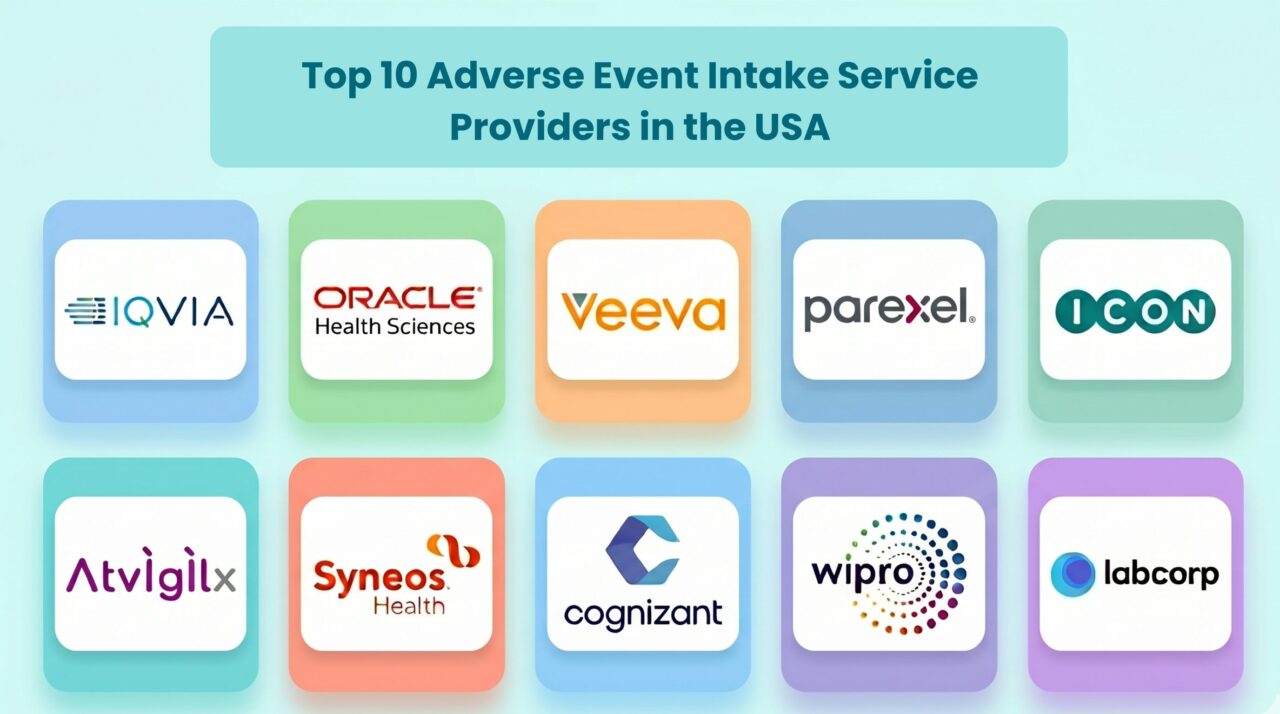
Top 10 Adverse Event Intake Service Providers in USA

Choose the best pharmacovigilance partner. Evaluate the top 10 US adverse event intake service providers on scale, compliance, and systems.
Adverse event (AE) intake services are a foundational component of pharmacovigilance and drug safety operations in the pharmaceutical and life sciences industry. These services ensure that safety data related to drugs, biologics, and medical devices is accurately captured, triaged, documented, and reported in compliance with FDA, EMA, and other global regulatory requirements.
For pharmaceutical sponsors, biotech companies, and clinical research organizations, AE intake is not just an administrative function, it is a compliance-critical process that directly impacts patient safety, regulatory inspection outcomes, and product lifecycle decisions. With increasing regulatory scrutiny and the growing volume of real-world safety data, organizations require partners that can deliver accuracy, scalability, and 24/7 operational reliability. regulatory requirements.
Selecting the right AE intake service provider is therefore a strategic decision for executives and pharmacovigilance leaders. The ideal provider must demonstrate strong regulatory expertise, validated systems, global processing capability, data quality controls, and the ability to integrate with safety databases and clinical systems. Cost efficiency, while important, is often secondary to compliance reliability and operational resilience.
Below is a curated list of the top 10 adverse event intake service providers in the United States, recognized for their contributions to pharmacovigilance operations, case processing excellence, and drug safety infrastructure support.
1. IQVIA
IQVIA is a global leader in life sciences analytics, clinical research services, and pharmacovigilance solutions. The company supports large-scale adverse event intake programs through multi-channel reporting systems, including call centers, digital portals, and integrated safety platforms.
Its AE intake services are designed to handle high-volume global reporting environments, making it a preferred partner for large pharmaceutical sponsors and multinational clinical programs. IQVIA also integrates real-world data and advanced analytics into its safety operations, supporting signal detection and regulatory decision-making.
The company’s strength lies in its global infrastructure and deep regulatory alignment, which enables consistent compliance across multiple jurisdictions.
Operational Strength | Massive global infrastructure, multi-channel intake frameworks (call centers, portals), and deep integration with proprietary real-world data (RWD) assets. |
Service Edge | Advanced analytical overlay that converts raw adverse event ingestion into actionable signal detection and life-cycle insights. |
Best Fit | Tier-1 global pharmaceutical enterprises managing multi-country commercial portfolios and massive clinical programs. |
2. Oracle Health Sciences (Argus Safety)
Oracle Health Sciences is widely recognized for its Argus Safety platform, one of the most established pharmacovigilance systems in the industry. Its AE intake and case management capabilities are embedded within a highly structured, compliance-driven workflow environment.
The platform enables standardized adverse event processing from intake through regulatory submission, ensuring traceability and audit readiness. It is extensively used by global pharmaceutical companies due to its configurability and regulatory robustness.
Oracle’s ecosystem approach allows integration with clinical trial systems, safety databases, and enterprise data platforms, supporting end-to-end pharmacovigilance operations.
Operational Strength | Gold-standard database architecture with highly disciplined, built-in, compliance-driven workflows. |
Service Edge | Unrivaled regulatory robustness, traceability, and audit readiness recognized universally by global inspectors. |
Best Fit | Enterprises prioritizing structural standardization and absolute system compliance across extensive, unified networks. |
3. Veeva Systems (Veeva Safety)
Veeva Systems provides a cloud-based pharmacovigilance suite designed for modern life sciences organizations. Its AE intake capabilities support real-time case capture, structured data entry, and automated validation workflows.
The platform is particularly relevant for organizations transitioning away from legacy on-premise systems toward cloud-native safety architectures. Its integration with clinical and regulatory systems allows improved data continuity across the product lifecycle.
Veeva’s adoption has grown among mid-to-large pharmaceutical companies seeking scalable and digitally unified safety operations.
Operational Strength | Cloud-native safety architecture featuring real-time automated data validation and rapid ingestion workflows. |
Service Edge | Seamless, real-time data continuity due to direct integration with the broader Veeva Development Cloud ecosystem (Clinical/Regulatory). |
Best Fit | Forward-thinking mid-to-large sponsors actively shifting away from restrictive legacy on-premise systems to unified cloud architectures. |
4. Parexel
Parexel is a global clinical research organization offering comprehensive pharmacovigilance and adverse event intake services across clinical trials and post-marketing settings. The company provides structured case intake, medical review, and regulatory reporting support.
Its global operations enable 24/7 safety processing and multilingual intake capabilities, which are essential for multinational clinical development programs. Parexel is known for combining clinical expertise with regulatory compliance knowledge.
The organization supports a wide range of therapeutic areas and study phases, making it a versatile pharmacovigilance partner.
Operational Strength | 24/7 global processing centers with extensive multi-lingual case intake capability across complex clinical and post-marketing pipelines. |
Service Edge | A strong blend of clinical research operations paired with highly specialized, therapeutic-specific medical review. |
Best Fit | Multinational clinical development programs requiring a single, high-touch partner to manage trial execution and safety simultaneously. |
5. ICON plc
ICON plc is a major global clinical research organization with established pharmacovigilance and AE intake capabilities. Its services are integrated into clinical development, post-marketing surveillance, and real-world evidence programs.
ICON operates global service centers that support continuous case intake and regulatory reporting. The company is often selected for large, complex clinical programs requiring scalable safety infrastructure.
Its operational strength lies in combining clinical execution capabilities with structured safety reporting frameworks.
Operational Strength | Deep scale in global service delivery centers optimized for high-volume, complex case intake. |
Service Edge | Highly systematic execution models that bridge post-marketing surveillance seamlessly with real-world evidence (RWE) initiatives. |
Best Fit | Large-scale, logistically complex clinical programs that demand robust, highly scalable data ingestion frameworks. |
6. Atvigilx
Atvigilx operates as a mid-sized service provider in the pharmacovigilance and adverse event intake domain, supporting pharmaceutical and biotech clients with case processing and safety reporting functions.
The company provides services that typically include case intake processing, data entry and reconciliation, literature surveillance support, and pharmacovigilance case management workflows. Its operating model is generally positioned to support organizations seeking flexible engagement structures and adaptable operational workflows.
Mid-tier providers such as Atvigilx are often engaged by sponsors requiring scalable support without the complexity of large enterprise systems. Their role in the market reflects the broader diversification of pharmacovigilance outsourcing models across the industry.
Operational Strength | Agile operational workflows focusing strictly on localized case entry, medical reconciliation, and literature surveillance. |
Service Edge | Highly flexible engagement structures without the administrative friction or rigid SLAs of massive enterprise providers. |
Best Fit | Small-to-mid-sized biotechs or specialty pharma sponsors looking for customized, adaptive attention over massive automated infrastructure. |
7. Syneos Health
Syneos Health delivers integrated biopharmaceutical solutions, including pharmacovigilance and adverse event intake services. The company combines clinical development, commercialization, and real-world evidence capabilities within a unified operational model.
Its AE intake services are supported by global teams capable of handling multilingual reporting and complex regulatory requirements. Syneos is frequently engaged for programs that require alignment between clinical insights and post-marketing safety surveillance.
The organization’s hybrid model allows it to support end-to-end product lifecycle requirements.
Operational Strength | A cohesive operational model designed to bridge the gap between commercial market insights and early-stage clinical safety data. |
Service Edge | Multi-jurisdictional compliance expertise managed by cross-functional teams optimized for the entire product lifecycle. |
Best Fit | Bio-pharmaceutical sponsors seeking a hybrid model that aligns late-stage clinical trial safety smoothly into full post-marketing launch surveillance. |
8. Cognizant
Cognizant provides pharmacovigilance outsourcing and drug safety services as part of its life sciences business unit. Its AE intake solutions leverage automation tools, digital workflows, and global delivery centers.
The company focuses on process optimization and operational efficiency, particularly for large pharmaceutical enterprises managing legacy systems. Its services are often positioned as transformation-oriented solutions for safety operations.
Cognizant’s global delivery structure supports continuous intake and case processing across time zones.
Operational Strength | Significant IT and business process outsourcing (BPO) footprint leveraging digital automation tools and worldwide delivery centers. |
Service Edge | High-efficiency optimization, making it an excellent vehicle for modernizing older legacy safety intake environments. |
Best Fit | Large enterprise pharma organizations looking to execute digital transformation and drive cost efficiencies in high-volume intake pipelines. |
9. Wipro
Wipro offers pharmacovigilance and AE intake services as part of its broader healthcare and life sciences portfolio. Its capabilities include case processing, safety database management, and regulatory support functions.
The company utilizes automation and standardized workflows to support large-scale pharmacovigilance operations. Its global delivery model enables cost-efficient processing across multiple geographies.
Wipro is commonly engaged for high-volume outsourcing programs requiring operational scalability and process standardization.
Operational Strength | Broad technical and life-sciences operational portfolio leaning heavily on standardized digital workflows and scaling methodologies. |
Service Edge | Excellent cost-to-value performance ratio across globally distributed, high-volume processing teams. |
Best Fit | High-volume pharmacovigilance outsourcing programs requiring strict adherence to process-driven, standardized data entry protocols. |
10. Labcorp Drug Development
Labcorp Drug Development (now part of Fortrea’s legacy clinical development operations in certain segments) provides pharmacovigilance and AE intake services integrated with clinical research and diagnostic capabilities.
The organization supports global case intake, medical coding, and regulatory reporting across clinical trials and post-marketing environments. Its established presence in clinical research contributes to its credibility in safety operations.
Labcorp’s pharmacovigilance services are often utilized by sponsors seeking strong clinical integration and established operational frameworks.
Operational Strength | Entrenched clinical trial presence backed by extensive global diagnostic networks and medical coding teams. |
Service Edge | Exceptional credibility and seamless safety hand-offs rooted in their foundational clinical laboratory data infrastructures. |
Best Fit | Sponsors deeply integrated into the Labcorp/Fortrea ecosystem who prefer a highly consolidated approach to trial safety data. |
Key Evaluation Criteria for AE Intake Providers
When evaluating adverse event intake service providers, decision-makers typically assess several core factors. Regulatory compliance capability is the most critical, followed by system validation, data quality controls, and inspection readiness.
Operational scalability, global coverage, and therapeutic expertise also play a major role, especially for sponsors running multinational trials or managing marketed products across regions. Increasingly, integration capability with safety databases and digital ecosystems has become a key differentiator.
Consequences of Selecting an Inadequate AE Intake Provider
Choosing an underperforming adverse event intake provider can result in significant regulatory and operational risks. One of the most immediate consequences is delayed or inaccurate safety reporting, which can lead to non-compliance with FDA, EMA, or other regulatory authorities.
Inconsistent case processing may also result in incomplete safety narratives, missed adverse event signals, and audit findings during regulatory inspections. These issues can escalate into warning letters, product delays, or reputational damage for the sponsor organization.
From a broader business perspective, weak pharmacovigilance execution can reduce stakeholder confidence and increase long-term remediation costs, making provider selection a high-impact strategic decision.
Why Some Organizations Choose Smaller or Mid-Sized Providers
While large CROs and technology providers dominate the pharmacovigilance landscape, some organizations prefer smaller or mid-sized service providers due to operational flexibility and responsiveness. These providers often offer more adaptable workflows and closer collaboration with sponsor teams.
Mid-sized providers can also offer more tailored service models, which may be beneficial for early-stage biotech firms or companies with evolving safety requirements. This flexibility can help optimize resource allocation without committing to rigid enterprise frameworks.
However, the decision typically depends on program complexity, regulatory exposure, and internal capability maturity. Many sponsors adopt a hybrid outsourcing strategy combining large-scale providers with specialized mid-tier partners.
The adverse event intake services market in the United States is shaped by a mix of global CROs, technology platforms, and specialized pharmacovigilance service providers. Organizations such as IQVIA, Oracle Health Sciences, and Veeva Systems dominate enterprise-scale operations, while providers like Atvigilx and other mid-tier firms contribute flexibility and operational diversity to the ecosystem.
For sponsors, executives, and pharmacovigilance leaders, the optimal choice depends on balancing compliance requirements, operational scale, technological maturity, and cost considerations. As regulatory expectations continue to evolve, AE intake providers will remain central to ensuring drug safety, data integrity, and patient protection across the pharmaceutical lifecycle.
How can sponsors identify the best adverse event intake service provider for their organization?
What are the business risks of selecting the wrong adverse event intake service provider?
Should pharmaceutical companies outsource adverse event intake services or build in-house capabilities?
What key performance indicators (KPIs) should executives use to evaluate adverse event intake providers?
Are large global CROs always the best choice for adverse event intake services?
How are technology and automation transforming adverse event intake services?
Recent Posts
- PV Audit Preparation Frameworks for International Auditors July 21, 2026
- Pharmacovigilance Outsourcing Services: A Strategic Advantage for Pharmaceutical and Biotech Companies July 16, 2026
- ICSR Processing Optimization for Multi-Country Submissions July 13, 2026
- PSUR Harmonization Across FDA, EMA, and CDSCO Requirements July 1, 2026
- A Sponsor’s Guide to Signal Detection for IND, NDA, BLA, and Post Marketing Programs June 22, 2026

Categories

Archives