Pharmacovigilance Risk Assessment: A Practical Framework for Sponsors Managing Emerging Safety Risks
👤 Dr. Sornaraja Thasma | 🗓️ 03 Aug, 2026 | 📂 Pharmacovigilance

Essential Pharmacovigilance Risk Assessment Framework for sponsors to assess emerging safety risks, evaluate signals, & make informed risk management decisions.
Introduction: When a Safety Signal Becomes a Business Decision
A safety signal rarely arrives with a clear answer.
It may begin with a small cluster of adverse event reports, an unexpected finding in a clinical study, a literature publication, or a pattern that appears only after a medicine reaches a larger patient population.
The difficult question for a pharmaceutical or biotech company is not simply whether the signal exists.
The real question is:
Does this emerging safety concern represent a meaningful risk, and what should we do about it?
That is where pharmacovigilance risk assessment becomes critical.
FDA notes that some safety problems may only become visible when medicines are used by much larger populations after approval. The agency also relies on complete, accurate, and timely safety information when evaluating product safety
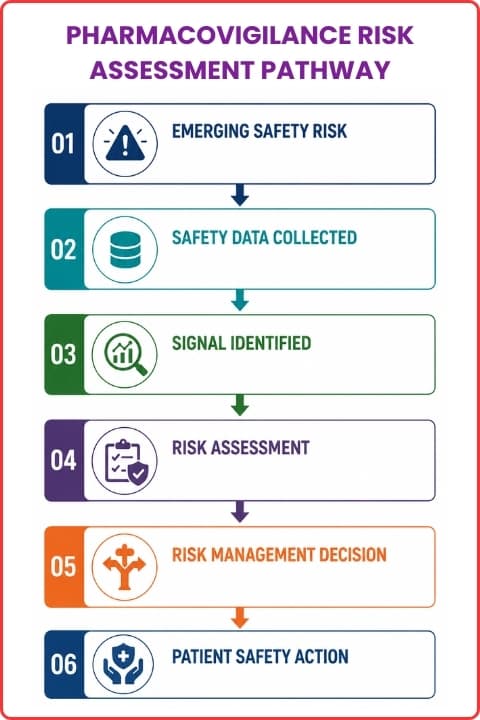
Why Emerging Safety Risks Require More Than Signal Detection
A new safety signal does not automatically mean that a product has a confirmed safety risk.
For example, suppose a company begins seeing reports of a particular adverse event following product launch. The initial number may appear concerning. But the reports could involve duplicate cases, incomplete information, underlying patient conditions, concomitant medicines, reporting stimulated by media attention, or other factors.
A responsible assessment therefore needs to move beyond counting cases.
The company needs to understand the clinical context, evaluate the available evidence, consider alternative explanations, assess the seriousness of the outcome, and determine whether the observed pattern changes the existing benefit risk profile.
This is why risk assessment should be connected to the wider pharmacovigilance system rather than treated as a standalone exercise.
EMA GVP Module V specifically addresses risk management systems, while Module IX addresses signal management.
A Practical Four Stage Framework for Pharmacovigilance Risk Assessment
A useful framework for sponsors can be built around four connected questions.
1. What exactly has changed?
Start with the signal itself.
Is the concern coming from spontaneous reports, clinical trial data, scientific literature, a post authorization safety study, a regulatory request, or another source?
The first step is to establish what is actually different from the previously understood safety profile.
This includes reviewing case narratives, seriousness, outcomes, patient characteristics, exposure, time to onset, concomitant therapies, medical history, and relevant laboratory or diagnostic findings.
The quality of the underlying data matters considerably. In the United States, FDA identifies four core elements for a valid postmarketing adverse event report: an identifiable patient, a suspect product, an adverse event or death, and an identifiable reporter.
A weak evidence base can make an emerging concern appear either more serious or less serious than it really is.
2. How strong is the evidence?
Once the signal has been characterized, the next step is evidence assessment.
This is where pharmacovigilance teams should resist the temptation to focus on a single number.
A higher number of reports may attract attention, but the interpretation depends on exposure, reporting patterns, clinical characteristics, background incidence, biological plausibility, and alternative explanations.
A useful assessment should ask whether the evidence is consistent across different data sources.
For instance, if spontaneous reports suggest a concern and similar findings appear in clinical studies or published literature, the signal may deserve greater attention. If the pattern disappears after duplicate cases are removed or alternative causes are identified, the interpretation may be different.
FDA’s FAERS database supports postmarketing safety surveillance and is updated quarterly, illustrating how continuously accumulating safety information can contribute to ongoing assessment.
3. What does the risk mean for patients?
Evidence alone is not enough.
The next question is clinical significance.
A relatively uncommon event may still represent a major concern if it results in hospitalization, permanent disability, or death. Conversely, a frequent event may have limited clinical consequences and may be manageable through appropriate labeling or monitoring.
Sponsors should therefore evaluate the seriousness, severity, reversibility, affected population, dose relationship, time to onset, and potential risk factors.
This is also where benefit risk thinking becomes important.
The assessment should consider whether the emerging risk changes the existing understanding of the medicine’s overall benefit risk profile or whether it can be managed within the current framework.
4. What action is proportionate?
The final question is where assessment becomes risk management.
Not every emerging signal requires the same response.
| Assessment Finding | Potential Sponsor Response |
|---|---|
| Limited evidence with no clear pattern | Continue monitoring and gather additional information |
| Consistent signal requiring further evaluation | Focused review, additional analysis, or targeted data collection |
| Important confirmed or suspected risk | Update safety information and strengthen risk controls |
| Serious risk requiring additional evidence | Consider additional pharmacovigilance activities or post authorization studies |
| Risk with meaningful patient impact | Implement or revise risk minimization measures and monitor effectiveness |
Table: Pharmacovigilance Risk Assessment Actions
The objective is proportionality.
EMA describes risk management as a process that includes measures to minimize potential risks and address knowledge gaps throughout a medicine’s lifecycle.
The Metrics That Help Safety Teams See Risk Clearly
Risk assessment becomes much more useful when teams track measurable indicators rather than relying only on narrative conclusions.
Useful metrics can include case volume and trend, reporting timeliness, serious case proportion, time from signal identification to assessment, number of cases with relevant clinical information, and effectiveness of risk minimization measures.
The point is not to create a long dashboard.
A small set of meaningful indicators can help safety leaders identify whether a concern is growing, whether information quality is improving, and whether the actions taken are actually working.
For example, a rising case count combined with increasing seriousness may require a different response than a rising count driven mainly by increased reporting awareness.
Metrics provide context. They do not replace medical judgment.
Connecting Risk Assessment With Risk Management Plans
A risk assessment should eventually connect with the product’s wider risk management strategy.
For products operating in the European Union, EMA states that an RMP is generally required with initial marketing authorization applications, subject to specific circumstances and exceptions. The RMP should reflect the known and potential safety concerns and the pharmacovigilance activities and risk minimization measures planned to address them.
Sponsors reviewing their safety strategy can also refer to Atvigilx’s Risk Management Plans for practical support around risk management activities.
The important point is that an RMP should not become a static regulatory document.
When new evidence materially changes the understanding of a safety concern, the risk management approach may also need to change.
What Happens When Risk Assessment Is Delayed?
Delay can create problems on several levels.
A signal may remain unresolved while more cases accumulate. Safety teams may spend additional time reviewing the same issue repeatedly because the initial assessment was not sufficiently structured. Regulatory questions may become more difficult to answer when the evidence trail is incomplete.
There is also an operational consequence.
If signal review, case processing, aggregate reporting, medical review, and risk management activities operate separately, important information can become fragmented across teams.
A stronger approach connects these activities.
The same safety concern identified during case review should be traceable through signal evaluation, aggregate assessment, regulatory communication, and risk management decisions.
That traceability becomes particularly valuable when a company needs to explain its reasoning during a regulatory inspection.
Building a Risk Assessment Process That Can Stand Up to Scrutiny
A strong pharmacovigilance risk assessment should be understandable months or even years after the original decision was made.
Someone reviewing the assessment should be able to determine what triggered the review, what evidence was considered, what limitations were identified, how the medical significance was evaluated, what conclusion was reached, and why the selected action was considered appropriate.
This documentation matters because pharmacovigilance is not only about identifying risks.
It is also about demonstrating that safety information was evaluated systematically and that decisions were supported by evidence.
EMA’s GVP framework includes dedicated modules covering pharmacovigilance systems, inspections, risk management, signal management, and periodic safety reporting.
For sponsors, that interconnected structure is important.
A safety signal should not exist in isolation from the wider safety system.
A Practical Question for Sponsors
The most useful question may not be:
“Do we have a safety signal?”
Instead, ask:
“If a regulator reviewed this safety concern today, could we clearly demonstrate how we identified it, assessed it, reached our conclusion, and decided what to do next?”
If the answer is uncertain, the issue may not be the absence of data.
It may be the absence of a structured risk assessment process.
Emerging safety risks are inevitable throughout the product lifecycle. The companies that manage them effectively are not necessarily those that have the fewest safety signals. They are the ones that can recognize meaningful changes, assess evidence objectively, document their reasoning, and respond proportionately.
That is ultimately what pharmacovigilance risk assessment should deliver: a defensible path from emerging evidence to patient safety action.
References
U.S. FDA, Postmarketing Adverse Event Reporting Compliance Program
FDA Postmarketing Adverse Event Reporting Compliance ProgramU.S. FDA, FDA Adverse Event Reporting System Database
FDA Adverse Event Reporting System DatabaseEuropean Medicines Agency, Good Pharmacovigilance Practices
EMA Good Pharmacovigilance PracticesEuropean Medicines Agency, Risk Management Plans
EMA Risk Management PlansEuropean Medicines Agency, Pre Authorization Guidance on Risk Management Plans
EMA Risk Management Plan Guidance
Expert Pharmacovigilance Risk Assessment Services
Facing Challenges With Emerging Safety Risks?
Emerging safety signals can create difficult decisions for pharmaceutical and biotech companies. Determining whether a signal represents a meaningful safety risk requires careful evaluation of evidence, clinical relevance, patient impact, and the potential need for risk management action.
From signal identification and safety data review to risk assessment, risk management planning, regulatory documentation, and ongoing monitoring, every part of the pharmacovigilance process needs to work together.
Atvigilx supports pharmaceutical and biotech companies with pharmacovigilance services designed around the evolving safety profile of medicinal products and the requirements of global regulatory authorities.
Our pharmacovigilance support can help with:
Pharmacovigilance risk assessment
Safety signal evaluation
ICSR review and case assessment
Signal detection and monitoring
Benefit risk assessment support
Risk management planning
Risk minimization strategy support
Aggregate safety reporting
Regulatory safety documentation
Safety data review and interpretation
Pharmacovigilance compliance support
Ongoing safety monitoring
Whether you are managing an established product, preparing for market authorization, or responding to an emerging safety concern, the risk assessment approach should reflect the available evidence, product profile, patient population, and applicable regulatory expectations.
Need Support With Pharmacovigilance Risk Assessment?
Get a Free Consultation to discuss your emerging safety risks and pharmacovigilance requirements. Atvigilx can support your safety assessment and risk management activities with a practical, evidence based approach.
Atvigilx | Pharmacovigilance Risk Assessment & Risk Management Support
Frequently Asked Questions
What is pharmacovigilance risk assessment?
How are emerging safety risks identified?
What happens after a safety signal is identified?
When should a safety signal trigger risk management action?
How can sponsors strengthen pharmacovigilance risk assessment?
Recent Posts
- Pharmacovigilance Risk Assessment: A Practical Framework for Sponsors Managing Emerging Safety Risks August 3, 2026
- PV Audit Preparation Frameworks for International Auditors July 21, 2026
- Pharmacovigilance Outsourcing Services: A Strategic Advantage for Pharmaceutical and Biotech Companies July 16, 2026
- ICSR Processing Optimization for Multi-Country Submissions July 13, 2026
- PSUR Harmonization Across FDA, EMA, and CDSCO Requirements July 1, 2026

Categories

Archives