PV Audit Preparation Frameworks for International Auditors
👤 Dr. Sornaraja Thasma | 🗓️ 21 July, 2026 | 📂 Pharmacovigilance

PV Audit Preparation Frameworks for International Auditors help sponsors and biotech companies prepare for successful global PV audits.
Why Global PV Audit Readiness Is More Critical Than Ever
Imagine receiving an audit notification from a global regulatory authority. Within days, your pharmacovigilance team begins gathering thousands of documents, reviewing SOPs, checking safety cases, validating training records, and revisiting CAPAs that were closed months ago.
This situation is familiar to many pharmaceutical and biotech companies, which is why PV audit preparation services have become an important part of inspection readiness. The pressure is not simply about passing an audit. It is about proving that patient safety has been consistently protected throughout the product lifecycle.
Today’s auditors expect much more than timely safety reporting. They want evidence that your entire pharmacovigilance system functions as one connected quality framework. Every decision, every safety case, every document, and every corrective action should be traceable.
Companies that adopt continuous audit readiness often report 30 to 40 percent fewer major inspection observations, while organizations with structured quality review programs spend significantly less time responding to regulatory findings. PV audit preparation is no longer a project that begins after receiving a notification. It has become an ongoing business process that strengthens both compliance and operational efficiency.
Understanding International Regulatory Expectations
Although international regulators share the same objective of protecting patient safety, each authority places emphasis on different operational areas during pharmacovigilance audits.
| Regulatory Authority | Primary Audit Focus | Common Documents Reviewed |
|---|---|---|
| FDA | Safety reporting compliance, quality systems | SOPs, ICSRs, CAPAs, training records |
| EMA | EU GVP compliance | PSMF, QPPV oversight, signal management |
| MHRA | Risk management and documentation | Risk management plans, CAPAs, deviations |
| PMDA | Local pharmacovigilance compliance | Local reporting records, procedures |
| Health Canada | Quality management consistency | SOPs, audit history, vendor oversight |
Despite their individual priorities, the FDA, EMA, MHRA, PMDA, and Health Canada all evaluate the same core pharmacovigilance principles during audits. These include documentation quality, regulatory reporting timelines, data integrity, employee competency, vendor oversight, and continuous quality improvement. Organizations that build a robust quality system around these shared expectations are better positioned to demonstrate compliance across multiple regulatory jurisdictions.
Framework 1: Build a Strong Pharmacovigilance Quality System
Every successful audit begins long before inspectors arrive.
The strongest pharmacovigilance organizations treat quality as part of everyday operations rather than a compliance exercise. Their procedures evolve alongside changing regulations, documentation is maintained continuously, and responsibilities remain clearly defined across departments.
A mature quality management system connects SOPs, training records, deviations, CAPAs, vendor oversight, management reviews, and regulatory reporting into one controlled process. When one area changes, the impact on related processes is evaluated immediately.
This level of integration allows organizations to answer auditor questions with confidence because evidence already exists. Teams are not searching for missing documents or trying to explain inconsistencies. Instead, they demonstrate a system that has been functioning effectively every day.
Framework 2: Verify Documentation Before Auditors Do
Regulators rarely rely on a single document when evaluating compliance.
They compare information across multiple records to understand whether documented processes truly reflect operational reality. An outdated SOP, inconsistent training record, or missing investigation report can quickly raise additional questions that extend throughout the audit.
This is why documentation reviews should become part of routine quality management rather than last minute preparation.
Every document tells part of the organization’s compliance story. Together they demonstrate whether quality systems are functioning effectively.
When documentation is accurate, consistent, and easily traceable, audit discussions become straightforward. When records conflict with one another, even minor discrepancies can create unnecessary regulatory concern.
Framework 3: Evaluate ICSR Quality Beyond Timelines
Meeting reporting timelines is essential, but regulators now expect much more than punctual submissions.
During pharmacovigilance audits, inspectors increasingly evaluate the quality of each Individual Case Safety Report. They review medical assessments, coding accuracy, seriousness evaluations, narrative consistency, expectedness determinations, follow up activities, and data reconciliation.
One well documented safety case often demonstrates the effectiveness of the entire pharmacovigilance process.
Organizations that conduct routine quality sampling gain valuable insight into recurring trends before they develop into regulatory findings. Instead of correcting individual errors after an audit, they improve the overall consistency of their safety operations.
The result is not only stronger compliance but also higher confidence in the reliability of safety data used for benefit risk evaluation.
Framework 4: Strengthen Vendor Oversight
Outsourcing pharmacovigilance activities has become common across the pharmaceutical industry, but accountability never leaves the sponsor.
Regulators expect organizations to maintain continuous visibility into outsourced activities. Simply signing a quality agreement is no longer enough.
Effective vendor oversight includes performance monitoring, governance meetings, quality metrics, periodic audits, issue escalation, and documented follow up activities. Every outsourced process should be supported by objective evidence demonstrating that quality standards remain consistently maintained.
Sponsors that actively monitor their vendors often identify operational risks much earlier, reducing both compliance exposure and business disruption.
Strong partnerships are built on transparency, continuous communication, and measurable quality performance.
Framework 5: Maintain Effective CAPA Management
Every organization encounters deviations.
What differentiates mature pharmacovigilance systems is how effectively those deviations are investigated, corrected, and prevented from recurring.
Auditors pay close attention to CAPA management because it reflects an organization’s commitment to continuous improvement. They look beyond the corrective action itself to understand whether the true root cause was identified and whether implemented actions successfully resolved the issue.
Effective CAPA programs follow a logical progression from issue identification to investigation, corrective action, preventive measures, effectiveness verification, and management review.
When CAPAs remain open for extended periods or repeatedly address the same issue, regulators may question the effectiveness of the overall quality management system.
Framework 6: Conduct Regular Mock Audits
The best time to identify compliance gaps is before regulators identify them.
Mock audits provide organizations with an opportunity to experience the pressure of a real inspection without regulatory consequences. Teams practice retrieving documents, responding to auditor questions, explaining operational processes, and demonstrating compliance through objective evidence.
These exercises frequently uncover overlooked weaknesses that routine operational reviews may miss.
Perhaps more importantly, mock audits improve confidence across departments. Employees become familiar with inspection expectations, communication improves between functional teams, and documentation becomes more organized long before official inspections occur.
Organizations that perform regular mock audits often enter regulatory inspections with significantly greater confidence and preparation.
Common Findings Reported During PV Audits
Many regulatory observations are surprisingly consistent across different authorities.
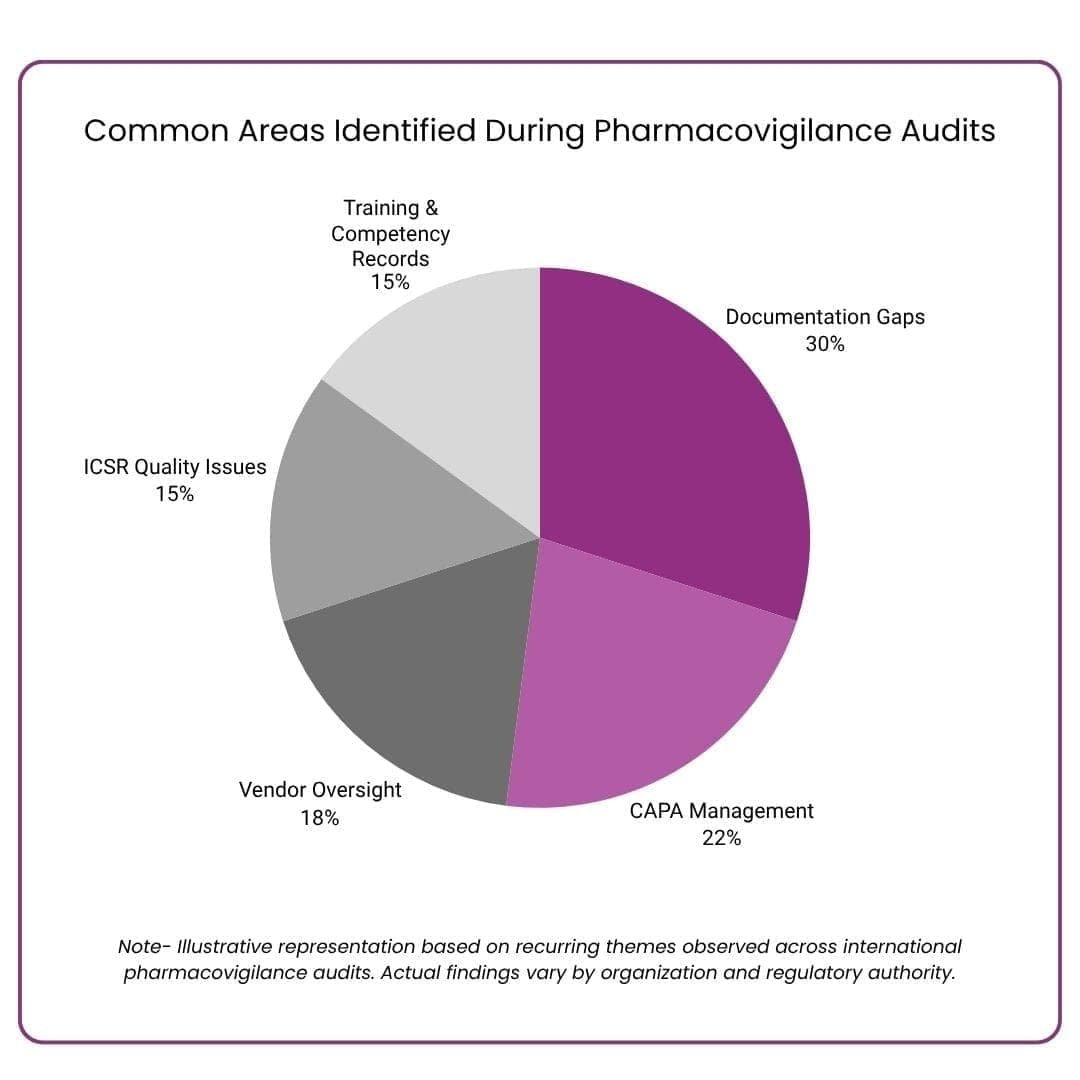
Incomplete SOP implementation continues to be one of the most common findings. Employees may understand procedures differently or continue following outdated versions.Documentation gaps remain another frequent observation, particularly where investigation records, training evidence, or quality reviews cannot fully support operational decisions.Vendor oversight sometimes lacks sufficient evidence demonstrating ongoing monitoring rather than contractual oversight alone.
CAPAs that remain incomplete or ineffective frequently attract regulatory attention because they suggest unresolved quality issues.The encouraging reality is that most of these findings are preventable through routine quality monitoring rather than intensive preparation immediately before an audit.
Building a Culture of Continuous Audit Readiness
Organizations with the strongest inspection histories rarely describe themselves as preparing for audits.
Instead, they describe themselves as always being ready.
Continuous audit readiness is built through consistent quality reviews, regular management oversight, timely document updates, periodic training, proactive vendor management, and open communication across departments.
When audit readiness becomes part of daily operations, inspections become opportunities to demonstrate organizational maturity rather than stressful compliance events.
This approach also delivers operational benefits beyond regulatory success. Teams spend less time searching for documentation, issues are resolved more quickly, decision making becomes more transparent, and patient safety remains at the center of every process.
Ultimately, continuous readiness creates a stronger pharmacovigilance system that supports long term regulatory confidence and sustainable business growth.
Supporting Global Audit Readiness
Preparing for international pharmacovigilance audits requires more than reviewing documents a few weeks before inspection. It requires an objective assessment of processes, quality systems, vendor oversight, safety reporting practices, and regulatory compliance across the entire organization.
Independent assessments help identify hidden compliance gaps before regulators do, allowing teams to strengthen documentation, improve operational consistency, and build greater confidence ahead of inspections.
Organizations looking to strengthen their inspection readiness can benefit from a dedicated PV Audit service that supports mock audits, compliance gap assessments, CAPA reviews, quality system evaluations, and ongoing pharmacovigilance oversight aligned with international regulatory expectations.
A pharmacovigilance audit is not simply a regulatory milestone. It is a reflection of how effectively an organization protects patient safety every single day.
The companies that consistently perform well during inspections are rarely the ones working the hardest a few weeks before an audit. They are the organizations that have invested in strong quality systems, continuous documentation, proactive oversight, and a culture where compliance is integrated into routine operations.
As international auditors continue to place greater emphasis on data integrity, quality management, vendor oversight, and risk based decision making, organizations that adopt structured audit preparation frameworks will be better positioned to demonstrate regulatory confidence across global markets.
The most successful audit strategy is simple. Build systems that are inspection ready every day, not just when an audit notice arrives. This mindset not only reduces regulatory risk but also strengthens operational excellence, improves efficiency, and reinforces the ultimate goal of pharmacovigilance, protecting patients through reliable and high quality drug safety practices.
Confident audits begin with the right preparation.
Facing challenges with pharmacovigilance audit readiness or preparing for an upcoming regulatory inspection? Take advantage of a free consultation with our pharmacovigilance specialists to identify compliance gaps, strengthen your quality system, and prepare with confidence for global regulatory inspections.
References
1. European Medicines Agency (EMA) – Good Pharmacovigilance Practices (GVP)
https://www.ema.europa.eu/en/human-regulatory-overview/post-authorisation/pharmacovigilance-post-authorisation/good-pharmacovigilance-practices-gvp
2. U.S. Food and Drug Administration (FDA) – Good Pharmacovigilance Practices and Pharmacoepidemiologic Assessment
https://www.fda.gov/regulatory-information/search-fda-guidance-documents/good-pharmacovigilance-practices-and-pharmacoepidemiologic-assessment
3. Medicines and Healthcare products Regulatory Agency (MHRA) – Good Pharmacovigilance Practice
https://www.gov.uk/guidance/good-pharmacovigilance-practice-gpvp
4. International Council for Harmonisation (ICH) – E2E Pharmacovigilance Planning
https://database.ich.org/sites/default/files/E2E_Guideline.pdf
5. CIOMS – Official Publications
The old pharmacovigilance product page is no longer available. Use the official CIOMS publications page instead.
https://cioms.ch/publications/
Frequently Asked Questions
What is a pharmacovigilance audit?
How do you prepare for a pharmacovigilance audit?
Which regulators conduct pharmacovigilance audits?
What documents are required for a pharmacovigilance audit?
Why is continuous pharmacovigilance audit readiness important?
Recent Posts
- PV Audit Preparation Frameworks for International Auditors July 21, 2026
- Pharmacovigilance Outsourcing Services: A Strategic Advantage for Pharmaceutical and Biotech Companies July 16, 2026
- ICSR Processing Optimization for Multi-Country Submissions July 13, 2026
- PSUR Harmonization Across FDA, EMA, and CDSCO Requirements July 1, 2026
- A Sponsor’s Guide to Signal Detection for IND, NDA, BLA, and Post Marketing Programs June 22, 2026

Categories

Archives