Good Clinical Practice in Pharmacovigilance - A Guide to Drug Safety Compliance

Introduction
Ensuring patient safety is one of the most critical responsibilities in clinical research and drug development. As pharmaceutical products move through clinical trials and into post-marketing use, continuous monitoring of safety data becomes essential to detect, assess, and prevent adverse drug reactions.
This is where Good Clinical Practice (GCP) and pharmacovigilance intersect. While GCP ensures that clinical trials are conducted ethically and scientifically, pharmacovigilance focuses on the ongoing monitoring of drug safety throughout the product lifecycle.
With the introduction of modern regulatory frameworks such as ICH E6(R3) Guideline, global regulators are emphasizing stronger sponsor oversight, risk-based quality management, and digital safety monitoring systems. These developments are transforming how pharmaceutical companies manage safety compliance and ensure patient protection.
This guide explores the role of Good Clinical Practice in pharmacovigilance, the regulatory framework governing drug safety, and emerging trends shaping the future of clinical safety monitoring.
What is Good Clinical Practice in Pharmacovigilance?
Good Clinical Practice (GCP) is an internationally recognized ethical and scientific standard for designing, conducting, recording, and reporting clinical trials involving human participants.
When integrated with pharmacovigilance activities, GCP ensures that:
- Clinical trial participants are protected.
- Safety data is collected accurately.
- Adverse events are reported promptly.
- Regulatory authorities receive reliable safety information.
The core objective is to ensure that drug safety data generated during clinical trials is credible, traceable, and compliant with global regulatory standards.
Pharmacovigilance activities during clinical trials include:
- Monitoring adverse events
- Reporting serious adverse events (SAEs)
- Signal detection and safety evaluation
- Risk assessment and mitigation
- Regulatory safety reporting
Together, these activities help ensure that investigational medicinal products are evaluated safely and responsibly.
Importance of Pharmacovigilance in Clinical Trials
Pharmacovigilance plays a critical role in identifying potential safety concerns during clinical development.
Clinical trials often involve limited patient populations, which means rare adverse reactions may not be immediately evident. Continuous safety monitoring allows researchers to detect safety signals early and implement appropriate risk mitigation strategies.
Key objectives of pharmacovigilance in clinical trials include:
- Early identification of adverse drug reactions
- Continuous monitoring of benefit-risk balance
- Compliance with global regulatory requirements
- Protection of trial participants
- Supporting regulatory decision-making
Effective pharmacovigilance systems ensure that safety concerns are detected promptly and that appropriate regulatory actions can be taken when necessary.
Key Regulatory Guidelines for Pharmacovigilance
Key Components of Pharmacovigilance in GCP
Drug safety monitoring during clinical trials is governed by several global regulatory frameworks. These regulatory frameworks provide the foundation for pharmacovigilance systems worldwide.
Some of the most important guidelines include:
| Guideline | Region | Focus |
| ICH E6(R3) Guideline | Global | Clinical trial conduct and quality |
| ICH E2D Guideline | Global | Post-marketing safety reporting |
| Good Pharmacovigilance Practices (GVP) | European Union | PV operational standards |
| U.S. Food and Drug Administration PV regulations | USA | Drug safety monitoring |
| Pharmacovigilance Programme of India | India | National drug safety reporting |
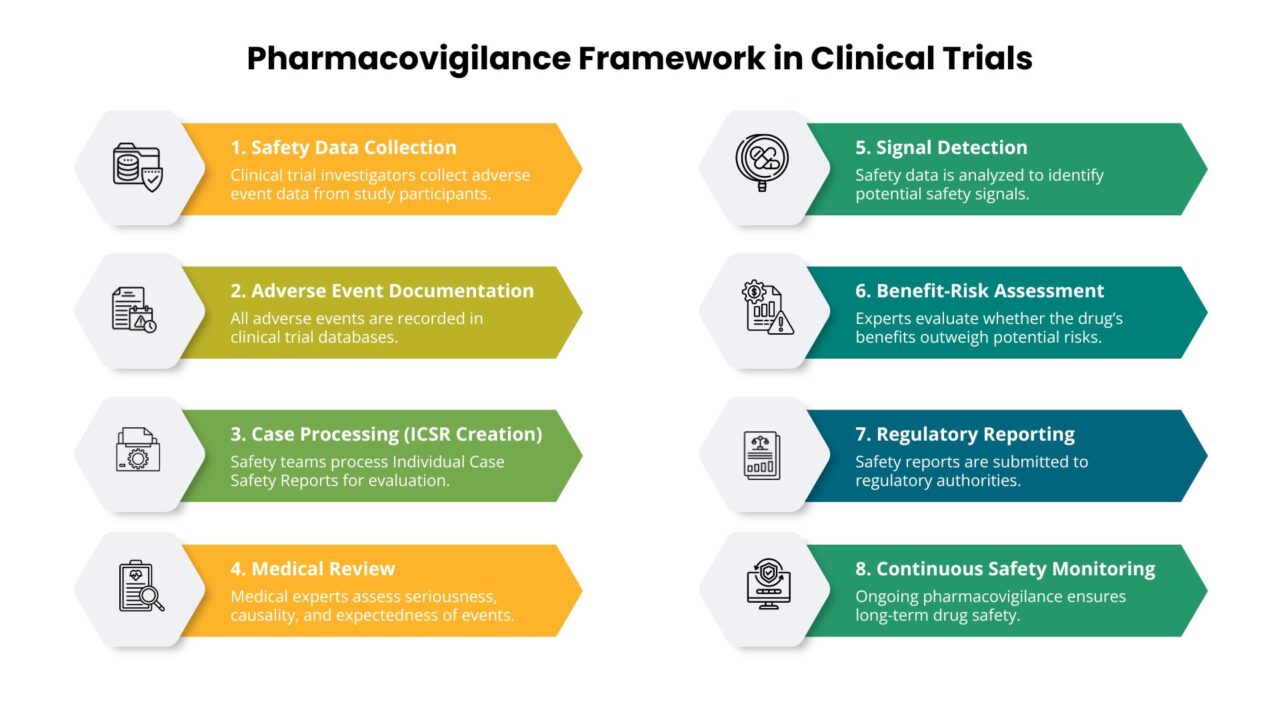
A robust pharmacovigilance system in clinical trials includes several critical components.
Adverse Event Reporting
Investigators must record and report adverse events occurring during clinical trials. Serious adverse events must be reported to sponsors and regulatory authorities within defined timelines.
Safety Data Collection
Accurate documentation of safety data ensures that investigators and regulators can evaluate potential safety risks associated with investigational products.
Signal Detection
Signal detection involves analyzing safety data to identify previously unknown or changing patterns of adverse drug reactions.
Risk Management
Sponsors must implement risk management strategies to minimize potential risks associated with investigational medicinal products.
Regulatory Reporting
Regulatory authorities require timely submission of safety reports such as:
- Individual Case Safety Reports (ICSRs)
- Development Safety Update Reports (DSURs)
- Periodic Safety Update Reports (PSURs)
These reports help regulators monitor drug safety throughout the development lifecycle.
Latest Regulatory Updates in GCP and Pharmacovigilance (2025–2026)
The regulatory landscape for pharmacovigilance continues to evolve in response to technological advancements and increasing safety expectations.
Recent updates emphasize stronger quality management systems and greater transparency in safety reporting.
Key developments include:
ICH E6(R3) Modernization
The revised ICH E6(R3) Guideline introduces:
- Risk-based quality management
- Improved sponsor oversight
- Digital data governance
- Adaptation to decentralized clinical trials
Updated Safety Reporting Requirements- Regulators are focusing on harmonizing global safety reporting processes, particularly for Individual Case Safety Reports.
Greater Emphasis on Patient-Centric Safety- Modern regulatory frameworks emphasize patient engagement and real-world safety data collection.
These updates are transforming pharmacovigilance practices across the pharmaceutical industry.
Risk-Based Quality Management in Pharmacovigilance
Risk-based quality management (RBQM) is a central concept in modern clinical research and pharmacovigilance.
Rather than applying uniform monitoring to all aspects of a clinical trial, RBQM focuses on identifying critical risk areas that could impact patient safety or data integrity.
Key elements include:
- Critical-to-Quality (CtQ) factors
- Risk identification and mitigation
- Centralized monitoring
- Continuous quality improvement
By focusing resources on the most critical safety risks, organizations can improve efficiency while maintaining high standards of patient protection.
Digital Transformation in Pharmacovigilance
Advances in technology are significantly transforming pharmacovigilance operations.
Pharmaceutical companies are increasingly adopting digital tools to improve the efficiency and accuracy of safety monitoring.
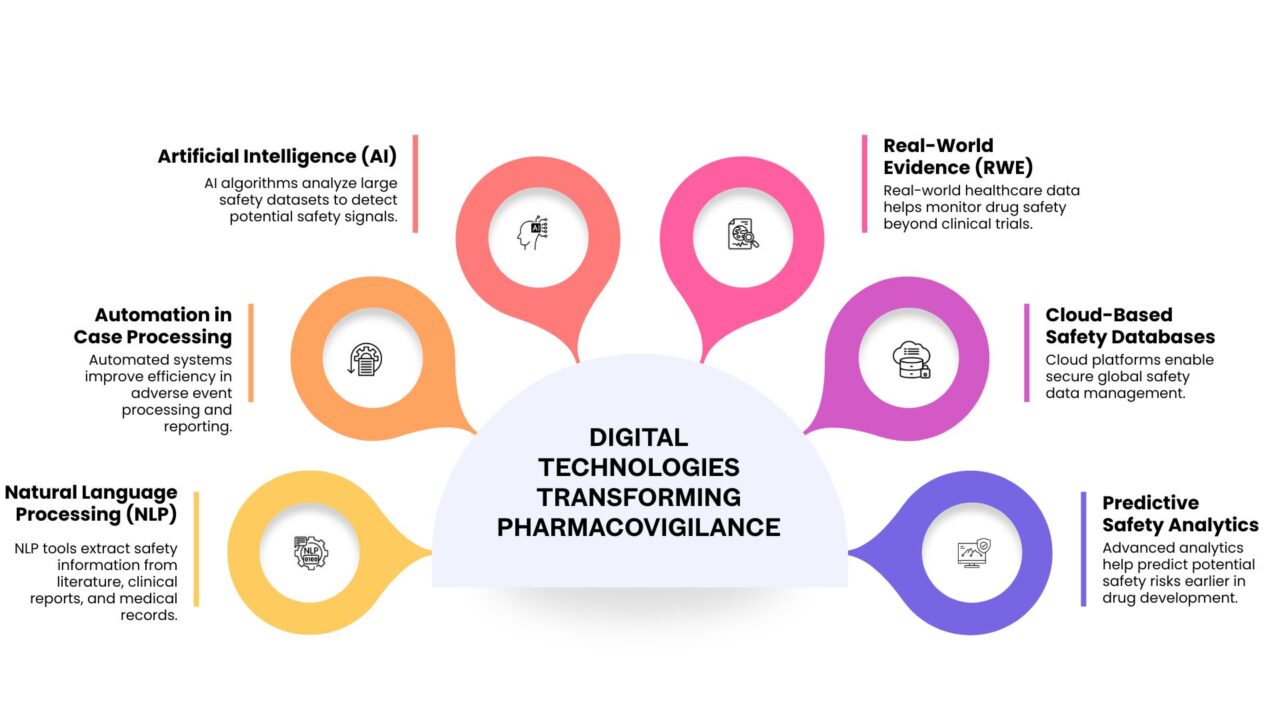
Key technological innovations include:
Artificial Intelligence in Signal Detection- AI algorithms can analyze large datasets to identify safety signals more efficiently than traditional methods.
Automation in Case Processing- Automated systems can process safety reports, reducing manual workload and improving reporting accuracy.
Natural Language Processing- NLP technologies can extract safety information from scientific literature, electronic health records, and social media data.
These technologies are helping organizations manage growing volumes of safety data while improving compliance and operational efficiency.
Real-World Evidence in Drug Safety Monitoring
Real-world evidence (RWE) is becoming an increasingly important component of pharmacovigilance.
While clinical trials provide controlled safety data, real-world data provides insights into how drugs perform in broader patient populations.
Sources of real-world data include:
- Electronic health records
- Patient registries
- Insurance claims databases
- Mobile health applications
Regulatory authorities increasingly rely on real-world evidence to evaluate long-term drug safety and effectiveness.
Pharmacovigilance Inspection Readiness
Regulatory inspections are a critical aspect of pharmacovigilance compliance.
Health authorities regularly conduct inspections to ensure that pharmaceutical companies maintain effective drug safety systems.
Organizations must demonstrate that they have:
- A well-maintained Pharmacovigilance System Master File (PSMF)
- Robust safety databases
- Documented safety procedures
- Vendor oversight processes
- Signal management systems
Maintaining inspection readiness requires continuous monitoring, documentation, and internal audits.
Common Pharmacovigilance Compliance Risks
Despite strong regulatory frameworks, organizations may encounter several compliance challenges.Addressing these risks proactively helps organizations maintain regulatory compliance and protect patient safety.
Some common risks include:
| Compliance Risk | Potential Impact |
| Delayed adverse event reporting | Regulatory penalties |
| Poor vendor oversight | Inspection findings |
| Inadequate signal detection | Patient safety risks |
| Incomplete documentation | Non-compliance with GVP |
| Weak quality management systems | Regulatory warnings |
Future Trends in Pharmacovigilance and Clinical Safety
The future of pharmacovigilance will be shaped by several emerging trends in clinical research and drug development.
Key trends include:
Decentralized Clinical Trials- Remote monitoring technologies and digital tools are enabling decentralized clinical trials, allowing participants to engage in studies from their homes.
AI-Driven Drug Safety- Artificial intelligence will continue to play a growing role in safety data analysis and signal detection.
Patient-Reported Safety Data- Mobile applications and digital health platforms are enabling patients to report adverse events directly.
Global Regulatory Harmonization- International regulatory collaboration is improving consistency in pharmacovigilance requirements across regions.
These developments will reshape how pharmaceutical companies manage safety monitoring in the coming years.
Conclusion
Good Clinical Practice plays a fundamental role in ensuring effective pharmacovigilance throughout the drug development lifecycle. By integrating ethical clinical research practices with robust safety monitoring systems, pharmaceutical organizations can protect patients while maintaining regulatory compliance.
As regulatory expectations continue to evolve, organizations must adopt risk-based quality management, digital pharmacovigilance tools, and real-world data strategies to enhance drug safety monitoring.
Companies that proactively strengthen their pharmacovigilance frameworks will be better positioned to meet global regulatory requirements and ensure the safe development of innovative therapies.
Read More: Drug Safety and Risk Management Plan (RMP) in Pharmacovigilance
Frequently Asked Questions (FAQs)
What is Good Clinical Practice in pharmacovigilance?
What is the main purpose of good clinical practice (GCP)?
Why is pharmacovigilance important in clinical trials?
What is the role of GVP in pharmacovigilance?
How does ICH E6(R3) impact clinical safety monitoring?
What technologies are transforming pharmacovigilance?
What are the three main GCP principles?
Recent Posts
- PV Audit Preparation Frameworks for International Auditors July 21, 2026
- Pharmacovigilance Outsourcing Services: A Strategic Advantage for Pharmaceutical and Biotech Companies July 16, 2026
- ICSR Processing Optimization for Multi-Country Submissions July 13, 2026
- PSUR Harmonization Across FDA, EMA, and CDSCO Requirements July 1, 2026
- A Sponsor’s Guide to Signal Detection for IND, NDA, BLA, and Post Marketing Programs June 22, 2026

Categories

Archives