Literature Screening and Review in Pharmacovigilance Simplified

Introduction
Literature screening and review in pharmacovigilance plays a critical role in identifying and monitoring the safety profile of medicinal products. As scientific publications continue to grow rapidly, pharmaceutical companies must systematically review global literature sources to detect potential adverse events and ensure regulatory compliance.
This process involves searching, screening, and evaluating scientific articles from databases such as PubMed, Embase, and other relevant journals. The goal is to identify Individual Case Safety Reports and safety signals that may impact the benefit risk profile of a drug.
In today’s highly regulated environment, literature monitoring is not just a routine task. It is a key component of a robust pharmacovigilance system that ensures patient safety and supports regulatory obligations across global markets.
What is Literature Screening in Pharmacovigilance
Literature screening is the process of scanning scientific and medical journals to identify relevant publications that report safety signals, adverse events, or any deviation from the expected benefit and risk profile of pharmaceutical products.
It is a regulatory requirement mandated by global health authorities such as the World Health Organization, U.S. Food and Drug Administration, and European Medicines Agency. Marketing Authorisation Holders are required to continuously monitor literature throughout the entire lifecycle of a product.
Key Objectives of Literature Screening
- Detect Individual Case Safety Reports
- Identify new or potential safety risks
- Ensure compliance with regulatory timelines and reporting requirements
- Validate that reported information aligns with global pharmacovigilance guidelines
Why is Literature Screening Essential
Literature screening is essential for maintaining drug safety and pharmacovigilance ensuring compliance with regulatory standards. Regulatory authorities require regular monitoring of literature to identify and report adverse drug reactions within defined timelines. This ensures that any emerging risks are detected early and addressed promptly.It also plays a vital role in identifying rare or unexpected safety signals that may not be observed during clinical trials.
Key benefits include:
- Early detection of safety signals
- Improved patient safety outcomes
- Compliance with global regulations
- Comprehensive coverage of global and local data sources
Process of Literature Screening in Pharmacovigilance
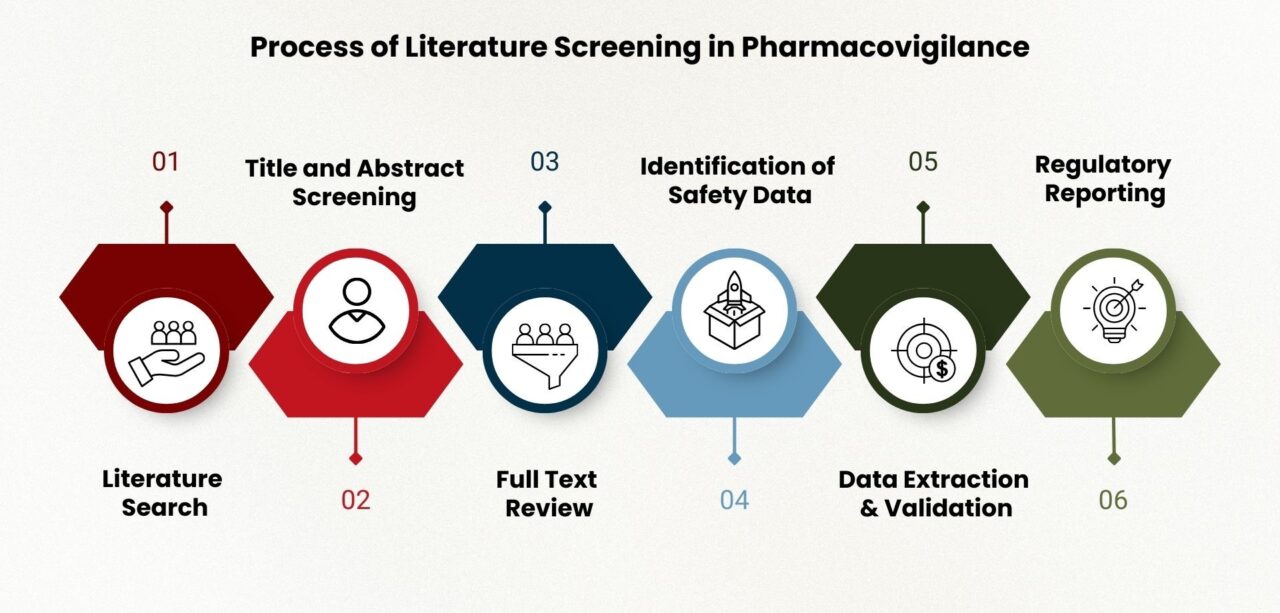
The literature screening process follows a structured workflow to ensure accuracy and consistency.It begins with identifying relevant databases and defining a search strategy using appropriate keywords. Articles are then screened based on titles and abstracts, followed by detailed full text review.During this process, pharmacovigilance professionals assess whether the content contains reportable safety information.
Core steps include:
- Literature search across databases and journals
- Title and abstract screening
- Full text review
- Identification of safety data
- Data extraction and validation
- Regulatory reporting
Challenges in Literature Screening and How Outsourcing Solves Them
Literature screening comes with several operational and compliance challenges. Outsourcing provides practical solutions to overcome these limitations effectively.
Challenge 1: High Volume of Scientific Literature
The increasing number of global publications makes it difficult for internal teams to manage screening efficiently and consistently.
Outsourcing solution:
- Dedicated teams handle large volumes efficiently
- Faster processing with structured workflowsReduced
- backlog and improved turnaround time
Challenge 2: Risk of Missing Critical Safety Data
Manual screening increases the chances of overlooking important adverse events or safety signals.
Outsourcing solution:
- Experienced pharmacovigilance professionals ensure accurate review
- Standardized processes minimize human error
- Multi level quality checks improve data reliability
Challenge 3: Regulatory Compliance Pressure
Strict global regulations require timely reporting, documentation, and audit readiness.
Outsourcing solution:
- Compliance driven workflows aligned with global standards
- Complete traceability and documentation
- Audit ready processes and reporting
Challenge 4: Resource and Cost Constraints
Building and maintaining an in house pharmacovigilance team can be expensive and difficult to scale.
Outsourcing solution:
- Cost effective operational model
- Access to trained experts without hiring overhead
- Flexible scaling based on workload
Challenge 5: Time Consuming Manual Processes
Manual literature screening is time intensive and may delay reporting timelines.
Outsourcing solution:
- Streamlined processes improve efficiency
- Faster turnaround for screening and reporting
- Better adherence to regulatory timelines
Best Practices for Effective Literature Screening
To ensure high quality literature screening and regulatory compliance, organizations must adopt a structured and consistent approach. A combination of well defined workflows, skilled professionals, and continuous monitoring is essential to maintain accuracy and efficiency.
Best practices include:
- Establish periodic monitoring schedules for global and local databases
- Train pharmacovigilance teams to identify relevant articles efficiently
- Collaborate with medical experts for complex case evaluation
- Conduct routine audits to ensure pharmacovigilance audit readiness
- Implement standardized workflows for consistency and quality
Why Outsourcing Literature Screening is a Strategic Advantage
In today’s evolving pharmacovigilance landscape, literature screening has become a compliance critical function that directly impacts patient safety and regulatory outcomes. Increasing literature volume and stricter global requirements make it challenging for organizations to maintain accuracy, consistency, and timely reporting with internal teams alone.
Outsourcing enables companies to leverage specialized expertise, scalable resources, and structured workflows without the burden of internal infrastructure. It not only improves operational efficiency but also strengthens compliance and risk management.
Key advantages of outsourcing include:
- Access to highly trained pharmacovigilance professionals
- Scalable resources to manage fluctuating workloads
- Improved compliance with global regulatory requirements
- Structured and standardized screening workflows
- Faster turnaround time and reduced backlog
- Cost optimization without compromising quality
- Enhanced audit readiness and documentation
Latest Trends in Literature Screening in Pharmacovigilance
Literature screening is rapidly evolving due to increasing data complexity and stricter regulatory expectations. Organizations are moving toward more proactive and structured approaches to ensure comprehensive safety monitoring.
Key trends include:
- Shift from periodic to continuous literature monitoring
- Increased focus on global and local database coverage
- Strong emphasis on data accuracy and traceability
- Standardization of workflows for consistency
- Growing preference for outsourcing pharmacovigilance activities
- Integration of literature screening with broader safety systems
- Increased regulatory scrutiny on documentation and reporting timelines
Literature Screening Outsourcing Services
Outsourcing providers offer end to end literature screening services that help pharmaceutical companies manage safety data efficiently while ensuring compliance with global regulations.
Services typically include:
- Development of customized search strategies
- Literature search across global and local databases
- Title and abstract screening
- Full text review and analysis
- Identification of Individual Case Safety Reports
- Data extraction and medical evaluation
- Quality control and validation processes
- Preparation and submission of regulatory reports
- Ongoing monitoring and periodic review support
In House vs Outsourced Literature Screening
| Factor | In House | Outsourced |
|---|---|---|
| Cost | High operational cost | Cost effective |
| Expertise | Limited | Specialized experts |
| Scalability | Difficult | Highly scalable |
| Compliance | Risk prone | Strong compliance |
| Efficiency | Slower | Faster turnaround |
Use Case Example
A mid sized pharmaceutical company faced challenges in managing increasing volumes of scientific literature. Their internal team struggled with delays and compliance risks due to limited resources. By outsourcing literature screening to a specialized pharmacovigilance partner, the company was able to streamline its workflow and significantly reduce turnaround time. The outsourced team implemented structured processes, improved data accuracy, and ensured timely reporting to regulatory authorities. This not only enhanced compliance but also allowed the company to focus on its core business operations.
Conclusion
Literature screening and review is a critical component of pharmacovigilance that ensures patient safety and regulatory compliance. However, managing this process internally can be challenging due to increasing data volumes and resource limitations.Outsourcing offers a practical and efficient solution by providing access to experienced professionals, scalable resources, and compliance driven workflows.If your organization is looking to simplify literature screening, improve efficiency, and ensure regulatory compliance, partnering with a trusted pharmacovigilance service provider can make a significant difference.
Read More: Purpose of Aggregate Reporting in Pharmacovigilance
Frequently Asked Questions
What is literature screening in pharmacovigilance?
Why is literature monitoring important?
What sources are used for literature screening?
What are the challenges in literature screening?
Why do companies outsource literature screening?
When should literature screening be outsourced?
Recent Posts
- PV Audit Preparation Frameworks for International Auditors July 21, 2026
- Pharmacovigilance Outsourcing Services: A Strategic Advantage for Pharmaceutical and Biotech Companies July 16, 2026
- ICSR Processing Optimization for Multi-Country Submissions July 13, 2026
- PSUR Harmonization Across FDA, EMA, and CDSCO Requirements July 1, 2026
- A Sponsor’s Guide to Signal Detection for IND, NDA, BLA, and Post Marketing Programs June 22, 2026

Categories

Archives