
ICH Guidelines for Periodic Safety Update Reports (PSUR): Key Compliance Insights!

Introduction
A periodic safety update report in pharmacovigilance (PSUR) is a crucial regulatory document used to evaluate the ongoing safety profile of medicines after they have been approved and introduced to the market. Regulatory authorities require periodic safety update reports for marketed drugs to ensure continuous monitoring of adverse events, emerging risks, and the overall benefit-risk balance of medicinal products.The PSUR ICH guideline, developed by the International Council for Harmonisation of Technical Requirements for Pharmaceuticals for Human Use, provides a harmonized framework for preparing and submitting these reports globally. By standardizing the structure and evaluation of safety data, the guideline helps pharmaceutical companies maintain regulatory compliance while ensuring patient safety.
PSURs play a central role in post-marketing pharmacovigilance by summarizing cumulative safety data, identifying potential safety signals, and supporting regulatory decisions regarding the continued use of medicinal products.
What is a Periodic Safety Update Report in Pharmacovigilance?
A Periodic Safety Update Report (PSUR) is a regulatory pharmacovigilance document that summarizes the safety experience of a medicinal product during a defined reporting period. It provides an integrated analysis of adverse events and evaluates whether the overall benefit–risk balance of the product remains favorable. PSURs are prepared by Marketing Authorization Holders (MAHs) and submitted to regulatory authorities to ensure that marketed medicines continue to meet established safety standards. These reports are particularly important for identifying rare or long-term adverse reactions that may not have been observed during clinical trials.
The purpose of a periodic safety update report in pharmacovigilance is to:
- Monitor drug safety after market approval
- Evaluate cumulative adverse event data
- Identify emerging safety signals
- Assess the overall benefit-risk balance of the product
By continuously evaluating safety information, PSURs help regulators maintain oversight of periodic safety update reports for marketed drugs, ensuring that healthcare professionals and patients continue to benefit from safe and effective medicines.
Importance of PSUR in Pharmacovigilance
The importance of a periodic safety update report in pharmacovigilance lies in its role as a structured mechanism for ongoing safety monitoring of approved medicinal products. PSURs enable pharmaceutical companies and regulatory authorities to systematically review new safety information collected from clinical use, spontaneous adverse event reports, and scientific literature. By evaluating cumulative safety data and conducting benefit-risk assessments, PSURs help identify potential safety signals that may require regulatory action or risk minimization measures. This process ensures that periodic safety update reports for marketed drugs contribute to maintaining patient safety, improving regulatory transparency, and supporting responsible lifecycle management of pharmaceutical products.
PSUR ICH Guidelines (ICH E2C R2)
The PSUR ICH guideline, specifically ICH E2C(R2), introduced the Periodic Benefit–Risk Evaluation Report (PBRER) format to improve the evaluation of post-marketing drug safety. This guideline provides a harmonized framework for preparing periodic safety reports for marketed medicinal products. The guideline was developed by the International Council for Harmonisation of Technical Requirements for Pharmaceuticals for Human Use to standardize pharmacovigilance reporting across global regulatory authorities such as the European Medicines Agency and the U.S. Food and Drug Administration.
The ICH E2C(R2) guideline defines the format, content, and evaluation process for PSUR/PBRER reports and emphasizes a comprehensive assessment of the benefit–risk balance of medicinal products throughout their lifecycle.
Key objectives of the guideline include:
- Standardizing pharmacovigilance reporting worldwide
- Improving evaluation of benefit–risk
- balanceEnhancing transparency in post-marketing safety monitoring
- Providing a structured format for PSUR/PBRER reports
The guideline also introduces important reporting concepts such as the Data Lock Point (DLP), which defines the cutoff date for safety data included in the report. By following the ICH E2C(R2) format, pharmaceutical companies ensure that regulatory authorities receive consistent, comprehensive, and scientifically evaluated safety data.
Key Components of a PSUR Report
A PSUR follows a structured format that allows regulators to review safety information efficiently. This standardized structure ensures consistency in regulatory submissions across regions.
Major components of a PSUR include:
| Section | Description |
| Introduction | Overview of the reporting period |
| Worldwide Marketing Status | Countries where the product is authorized |
| Actions Taken for Safety | Regulatory actions related to safety |
| Exposure Data | Estimated patient exposure |
| Data from Clinical Trials | Safety findings from studies |
| Post-Marketing Data | Individual case safety reports |
| Signal Evaluation | Assessment of emerging safety signals |
| Benefit-Risk Analysis | Overall safety evaluation |
Periodic Safety Update Reports for Marketed Drugs
Periodic safety update reports for marketed drugs play a vital role in monitoring the safety profile of medicinal products after they have been approved for public use. While clinical trials provide initial safety data, long-term and rare adverse reactions may only become evident once a drug is widely used in real-world healthcare settings. Through the preparation of a periodic safety update report in pharmacovigilance, Marketing Authorization Holders analyze cumulative adverse event data, evaluate emerging safety signals, and assess whether the benefit-risk balance of the medicine remains favorable. These reports provide regulators with ongoing insights into product safety and help ensure that marketed medicines continue to meet regulatory safety standards throughout their lifecycle.
PSUR Submission Timelines
Compliance with PSUR submission timelines is critical for regulatory approval and continued product authorization. The Data Lock Point (DLP) represents the cutoff date for safety data included in the report. Failure to meet these submission timelines may lead to regulatory penalties or delays in product lifecycle management.
| Reporting Interval | Submission Deadline |
| Up to 12 months | Within 70 days after Data Lock Point |
| More than 12 months | Within 90 days after Data Lock Point |
PSUR Compliance and Submission Requirements
Periodic Safety Update Reports must comply with regulatory requirements defined in the ICH E2C(R2) guideline and regional pharmacovigilance regulations. Marketing Authorization Holders are responsible for ensuring that PSURs are prepared, reviewed, and submitted according to the required format and timelines.
Compliance with PSUR submission requirements involves collecting comprehensive safety data, performing benefit–risk evaluations, and documenting findings in the standardized reporting structure. These reports must be submitted to regulatory authorities such as the European Medicines Agency, the U.S. Food and Drug Administration, or the Central Drugs Standard Control Organization depending on the region of authorization.
Key compliance requirements include:
- Preparing PSURs according to the ICH E2C(R2) format
- Ensuring accuracy and completeness of safety data
- Adhering to defined PSUR submission timelines
- Following regulatory guidance for electronic submission systems
- Maintaining documentation for regulatory inspections
Failure to comply with PSUR submission requirements may result in regulatory actions, including requests for additional safety data, delayed approvals, or penalties.
List of Union Reference Dates and Frequency of Submission of PSUR
In the European Union, the List of Union Reference Dates (EURD list) determines the frequency and submission schedule for PSURs.The List of Union reference dates and frequency of submission of periodic safety update reports ensures harmonized pharmacovigilance reporting across EU member states.
The EURD list defines:
- Reporting intervals for active substances
- Data lock points for safety reporting
- PSUR submission schedules
- Joint regulatory assessments
This harmonized system improves efficiency and consistency in safety monitoring.
PBRER vs PSUR
Many professionals often compare PBRER vs PSUR when discussing pharmacovigilance reporting formats. Although the PBRER format is widely adopted today, many regulatory authorities still refer to the document as a PSUR.
| Feature | PSUR | PBRER |
| Focus | Safety updates | Benefit-risk evaluation |
| Guideline | Earlier reporting approach | ICH E2C(R2) standard |
| Scope | Safety data summary | Safety and benefit analysis |
| Usage | Traditional terminology | Current global format |
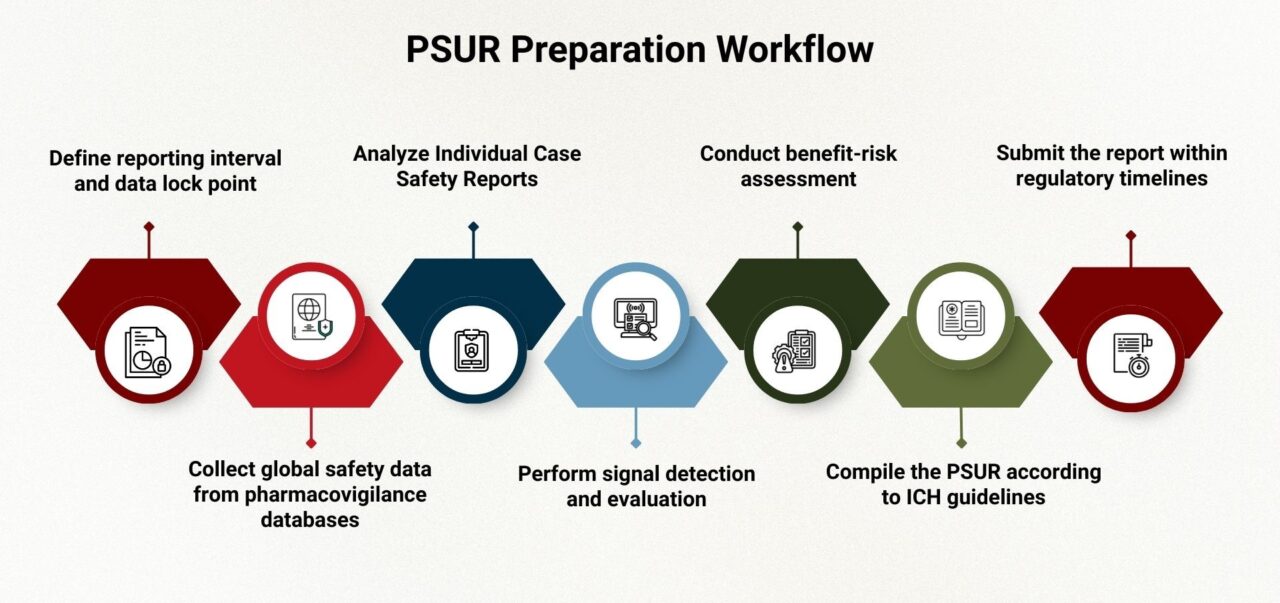
PSUR Preparation Workflow
Preparing a PSUR involves a systematic process to ensure accurate evaluation of safety data.
Typical workflow includes:
- Define reporting interval and data lock point
- Collect global safety data from pharmacovigilance databases
- Analyze Individual Case Safety Reports
- Perform signal detection and evaluation
- Conduct benefit-risk assessment
- Compile the PSUR according to ICH guidelines
- Submit the report within regulatory timelines
A well-defined workflow ensures efficient preparation and regulatory compliance.
Role of Marketing Authorization Holders (MAHs)
Marketing Authorization Holders are responsible for monitoring the safety of their products after approval.
Their responsibilities include:
- Collecting adverse event data
- Conducting safety signal detection
- Preparing periodic safety update reports
- Ensuring timely submission to regulatory authorities
- Maintaining pharmacovigilance systems
Strong pharmacovigilance infrastructure is essential for MAHs to meet regulatory obligations.
Global Regulatory Requirements for PSUR
Although the PSUR framework is harmonized globally, regulatory requirements may vary slightly across regions. Different regulatory authorities may have specific expectations regarding reporting frequency, submission formats, and safety evaluation procedures.
- European Union
PSUR submissions follow the EURD list and centralized evaluation procedures. These reports are assessed through coordinated regulatory reviews managed by the European Medicines Agency to ensure consistent pharmacovigilance oversight across EU member states. - United States
Similar safety updates are submitted through periodic safety reports aligned with FDA regulations. Pharmaceutical companies must follow reporting requirements defined by the U.S. Food and Drug Administration for post-marketing safety monitoring. - India
In India, pharmaceutical companies submit PSURs to the Central Drugs Standard Control Organization as part of post-marketing surveillance requirements. These reports help regulators monitor adverse drug reactions and ensure the continued safety of approved medicines.
Latest Regulatory Updates in PSUR Guidelines
Recent regulatory developments have strengthened the role of the periodic safety update report in pharmacovigilance by emphasizing a more comprehensive benefit–risk evaluation of marketed medicines. Global regulators continue to align their safety monitoring frameworks with the ICH E2C(R2) guideline, which introduced the Periodic Benefit-Risk Evaluation Report (PBRER) format for improved pharmacovigilance reporting. Agencies such as the European Medicines Agency and the U.S. Food and Drug Administration increasingly require structured safety analyses, signal evaluation, and cumulative benefit-risk assessment in PSUR submissions. Regulatory authorities also emphasize compliance with the List of Union reference dates and frequency of submission of periodic safety update reports (EURD list) to harmonize reporting schedules across regions. These updates ensure that periodic safety update reports for marketed drugs provide regulators with consistent and reliable safety data throughout the product lifecycle.
Challenges in PSUR Compliance
Despite clear regulatory guidance, pharmaceutical companies often face several challenges in maintaining compliance with periodic safety update report in pharmacovigilance requirements. One major challenge is collecting and integrating large volumes of global safety data from multiple pharmacovigilance databases and clinical sources. Ensuring consistency in safety evaluations across different markets can also be difficult when regulatory expectations vary by region. In addition, strict PSUR submission timelines require efficient coordination between safety teams, medical experts, and regulatory departments. Failure to manage these processes effectively can lead to delayed submissions or incomplete safety evaluations, potentially resulting in regulatory queries or compliance risks. As pharmacovigilance regulations continue to evolve, maintaining high-quality and timely periodic safety update reports for marketed drugs remains a critical responsibility for Marketing Authorization Holders.
Best Practices for PSUR Preparation
Pharmaceutical companies can improve PSUR quality by implementing effective practices such as:
- Maintaining centralized safety databases
- Automating safety data collection processes
- Monitoring regulatory guideline updates regularly
- Aligning PSURs with risk management plans
- Conducting proactive safety signal detection
These practices help ensure timely and accurate safety reporting.
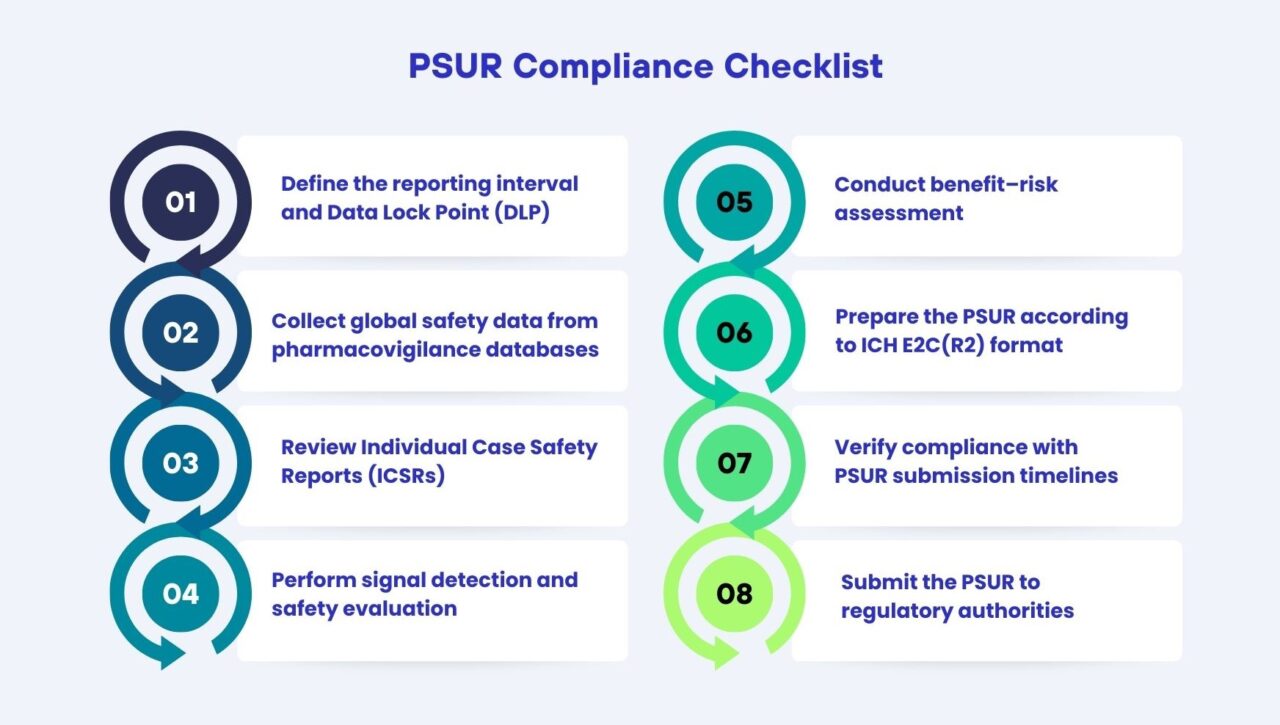
PSUR Compliance Checklist
A structured checklist helps ensure that all regulatory requirements are met during PSUR preparation.
PSUR Compliance Checklist
Define the reporting interval and Data Lock Point (DLP)
✔ Collect global safety data from pharmacovigilance databases
✔ Review Individual Case Safety Reports (ICSRs)
✔ Perform signal detection and safety evaluation
✔ Conduct benefit–risk assessment
✔ Prepare the PSUR according to ICH E2C(R2) format
✔ Verify compliance with PSUR submission timelines
✔ Submit the PSUR to regulatory authorities
Future Trends in Pharmacovigilance Reporting
The future of pharmacovigilance reporting is increasingly driven by digital technologies, global regulatory harmonization, and data-driven safety monitoring. Emerging tools such as artificial intelligence and advanced data analytics are being used to improve signal detection and streamline the preparation of periodic safety update reports in pharmacovigilance. Regulatory agencies are also encouraging greater integration of real-world evidence and patient safety data in post-marketing surveillance activities. As safety monitoring systems become more sophisticated, pharmaceutical companies are expected to adopt automated workflows and standardized reporting processes for periodic safety update reports for marketed drugs. These advancements will help enhance transparency, improve risk assessment, and support more proactive pharmacovigilance practices in the future.
Conclusion
Periodic Safety Update Reports remain a cornerstone of modern pharmacovigilance systems. By summarizing cumulative safety data and evaluating emerging risks, PSURs ensure that medicines continue to meet regulatory safety standards after approval.Following the PSUR ICH guideline, monitoring PSUR submission timelines, and tracking updates to the List of Union reference dates and frequency of submission of periodic safety update reports are essential responsibilities for pharmaceutical companies.As pharmacovigilance systems evolve with technological advancements and global regulatory harmonization, PSUR reporting will continue to play a vital role in protecting patient safety and maintaining the safe use of medicines worldwide.
Read More: PSUR and DSUR in Pharmacovigilance Quick Guide
Frequently Asked Questions (FAQs)
What is a periodic safety update report in pharmacovigilance?
What are PSUR submission timelines?
What is the EURD list?
What is the difference between PBRER and PSUR?
Who prepares periodic safety update reports (PSURs)?
Recent Posts
- PV Audit Preparation Frameworks for International Auditors July 21, 2026
- Pharmacovigilance Outsourcing Services: A Strategic Advantage for Pharmaceutical and Biotech Companies July 16, 2026
- ICSR Processing Optimization for Multi-Country Submissions July 13, 2026
- PSUR Harmonization Across FDA, EMA, and CDSCO Requirements July 1, 2026
- A Sponsor’s Guide to Signal Detection for IND, NDA, BLA, and Post Marketing Programs June 22, 2026

Categories

Archives