
Post-Marketing Surveillance (PMS) in Regulatory Affairs: A Complete Guide
👤 Dr. Sornaraja Thasma | 🗓️ 24 March, 2026 | 📂 Regulatory Affairs

Introduction
Post-Marketing Surveillance (PMS) has become a critical pillar in regulatory affairs as pharmaceutical and medical device companies face increasing scrutiny from global health authorities. While clinical trials provide initial safety and efficacy data, they cannot fully predict how a product will behave in real-world settings.This is where PMS plays a vital role. It ensures continuous monitoring of products after approval, helping organizations detect risks early, maintain compliance, and protect patient safety.
In today’s highly regulated and data-driven healthcare environment, PMS is no longer a passive obligation but a strategic necessity. With the growing use of real-world evidence, digital health technologies, and global safety databases, companies are expected to proactively identify risks and respond swiftly. A strong PMS framework not only supports regulatory compliance but also enhances product credibility and market sustainability.
What is Post-Marketing Surveillance in Regulatory Affairs
Post-Marketing Surveillance refers to the ongoing process of monitoring the safety and performance of a product after it has been launched in the market. It involves collecting real-world data, analyzing adverse events, and ensuring that the benefit-risk profile of the product remains acceptable.Unlike pre-approval studies, PMS captures insights from a much broader and more diverse patient population, making it essential for long-term safety evaluation.
From a regulatory affairs perspective, PMS is a structured and mandatory function that aligns with global guidelines and reporting obligations. Regulatory authorities require companies to continuously evaluate product safety through defined mechanisms such as periodic reports, risk management plans, and post-authorization studies. This ensures that any emerging risks are identified early and appropriate actions, such as label updates or safety communications, are implemented without delay.
Role of PMS in Pharmacovigilance Systems
Post marketing surveillance in pharmacovigilance is not just a regulatory requirement but a continuous scientific process. It integrates real-world data with clinical knowledge to identify emerging safety signals and improve patient outcomes.It acts as a bridge between regulatory compliance and proactive risk management, ensuring that any new risks are identified and addressed promptly.
Additionally, PMS in pharmacovigilance plays a crucial role in signal detection and validation by leveraging multiple data sources such as spontaneous reporting systems, electronic health records, and scientific literature. Advanced analytics and automation are increasingly being used to enhance signal detection accuracy and reduce manual workload. This evolution allows pharmacovigilance teams to move from reactive safety monitoring to a more predictive and preventive approach, ultimately strengthening patient safety and regulatory confidence.
How Drugs Are Monitored After Approval
Post marketing surveillance of drugs focuses on understanding how pharmaceutical products perform outside controlled clinical environments. Once a drug is used by thousands or millions of patients, rare adverse reactions and long-term effects may begin to surface. This ongoing monitoring allows companies and regulators to update safety labels, restrict usage if necessary, or even withdraw products in extreme cases, helping maintain public health trust.
It also helps identify drug interactions, population-specific risks, and real-world usage patterns that may not be evident during clinical trials, ensuring continuous evaluation of the benefit-risk profile.
Post Market Surveillance in Medical Devices
Medical devices present unique challenges compared to drugs because their performance can depend on user behavior, environmental conditions, and long-term usage.
Key focus areas include:
- Monitoring device performance in real-world settings
- Reporting incidents and malfunctions
- Implementing corrective and preventive actions
- Conducting post-market clinical follow-up studies
In this context, medical device vigilance plays a critical role in identifying and managing device-related risks throughout the product lifecycle. It ensures timely detection of safety issues, supports regulatory compliance, and helps manufacturers take corrective actions before risks escalate.
This makes PMS essential for ensuring both safety and functionality of devices over time while maintaining trust among healthcare providers and patients.
Understanding Post-Marketing Surveillance Studies
A post marketing surveillance study is typically conducted to gather additional data that was not fully captured during clinical trials. These studies are often required by regulators to further evaluate safety or effectiveness in specific populations.
Common types of PMS studies:
- Observational studies
- Patient registries
- Cohort and case-control studies
- Post-Authorization Safety Studies (PASS)
Such studies provide deeper insights into long-term risks and real-world outcomes.
Real-World Examples of Post-Marketing Surveillance
Understanding PMS becomes easier when we look at real-world scenarios where it has made a significant impact.
Examples include:
- Identification of rare side effects after widespread drug use
- Detection of drug interactions in specific patient groups
- Medical device recalls due to safety issues
- Label updates based on new safety findings
- Long-term safety concerns identified through registries
These examples highlight how PMS directly contributes to patient safety and regulatory decision-making.
How to Prepare a Post-Marketing Surveillance Report
A post marketing surveillance report is a comprehensive document that summarizes safety data collected over a defined period. It plays a crucial role in regulatory submissions and decision-making.
It typically includes:
- Summary of adverse events
- Signal detection outcomes
- Benefit-risk evaluation
- Risk mitigation strategies
- Final conclusions for regulatory authorities
These reports ensure transparency and help regulators assess whether a product should continue to remain on the market. They also support ongoing compliance by aligning with regulatory requirements such as Periodic Safety Update Reports (PSURs) and other aggregate reporting obligations.A well-prepared PMS report not only facilitates regulatory review but also enables organizations to make informed safety and risk management decisions.
FDA Requirements for Post-Market Safety Monitoring
The U.S. Food and Drug Administration requires companies to actively monitor product safety even after approval. PMS under FDA is not a passive activity but a structured and mandatory process.
Key requirements include:
- Adverse event reporting through MedWatch
- Risk Evaluation and Mitigation Strategies (REMS)
- Post-marketing commitments and studies
- Continuous safety monitoring
The FDA increasingly emphasizes real-world data and proactive risk management.
EMA Guidelines for Post-Authorization Safety Monitoring
The European Medicines Agency has established a robust PMS framework through Good Pharmacovigilance Practices (GVP).Unlike traditional approaches, EMA focuses on continuous benefit-risk evaluation throughout the product lifecycle. It also promotes the use of advanced analytics and real-world evidence.
Core elements include:
- Signal detection and management
- Risk Management Plans (RMPs)
- Periodic Safety Update Reports (PSURs)
- Post-Authorization Safety Studies (PASS)
Post Marketing Surveillance in India
In India, PMS is regulated under the Pharmacovigilance Programme of India, which aims to ensure drug safety across the country.The Indian regulatory system is rapidly evolving, with increased emphasis on digital reporting and global alignment.
Key requirements:
- Adverse drug reaction reporting
- Signal detection and evaluation
- Risk communication
- Compliance with CDSCO guidelines
Key Components of an Effective PMS System
An effective Post-Marketing Surveillance system is built on multiple interconnected processes that work together to ensure continuous safety monitoring and regulatory compliance. These components not only help in identifying risks but also enable proactive decision-making throughout the product lifecycle.
A well-structured PMS framework integrates clinical knowledge, real-world data, and regulatory requirements to maintain a strong benefit-risk profile. It also ensures that any emerging safety concerns are quickly evaluated and addressed.
Core Components include:
- Adverse Event Reporting – Collection and documentation of adverse drug reactions from healthcare professionals, patients, and literature sources
- Signal Detection and Management – Identification, validation, and assessment of potential safety signals using aggregated data
- Periodic Safety Reporting – Preparation of reports such as PSURs and DSURs to provide ongoing safety updates to regulators
- Risk Management Planning – Development and execution of strategies to minimize identified and potential risks
- Post-Marketing Studies – Conducting PASS and observational studies to generate additional real-world evidence
- Literature Monitoring – Continuous screening of scientific publications for safety-related information
- Regulatory Compliance Tracking – Ensuring alignment with global regulatory requirements and timelines
- Benefit-Risk Evaluation – Continuous assessment of whether the therapeutic benefits outweigh potential risks
Post-Marketing Surveillance Process Flow
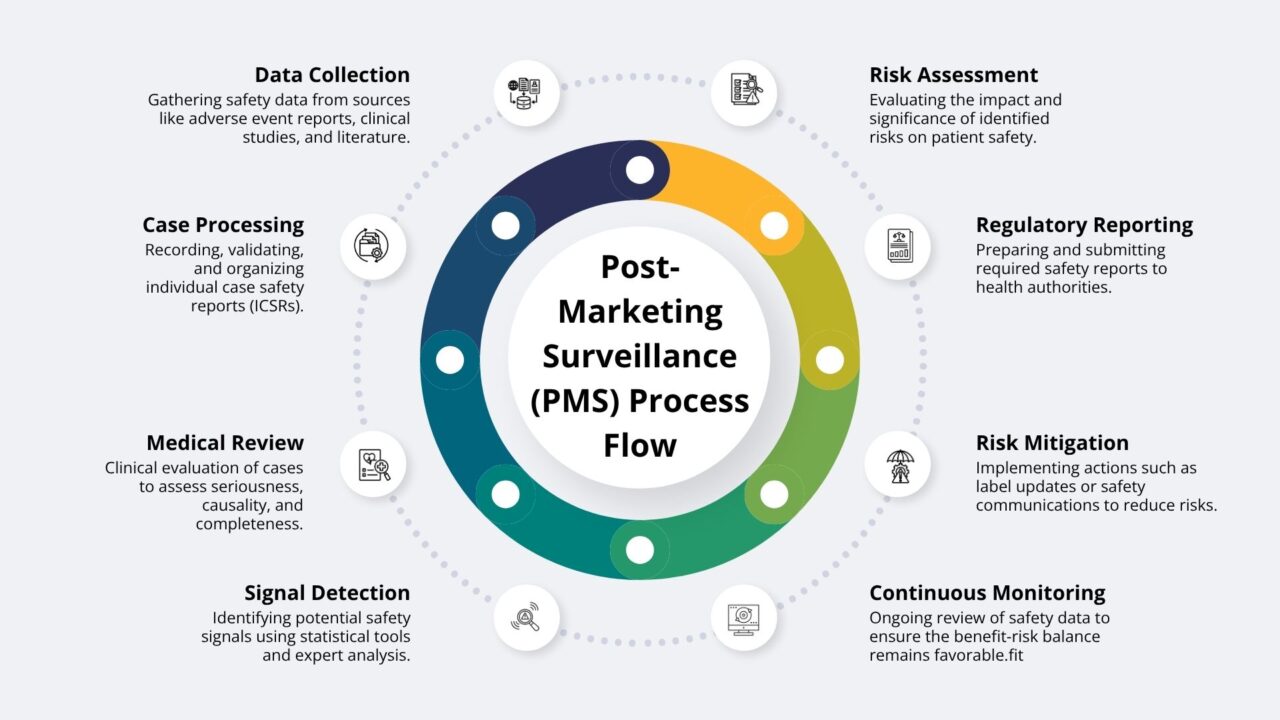
The post-marketing surveillance process follows a structured and systematic approach to ensure that safety data is continuously monitored, evaluated, and reported in compliance with regulatory requirements. It helps organizations move from raw data collection to meaningful safety insights and risk mitigation.
A well-defined PMS workflow not only improves efficiency but also ensures timely identification of safety signals and supports proactive regulatory decision-making.
Detailed Process Flow:
- Data collection from multiple sources such as spontaneous reports, clinical studies, and literature
- Case intake, triage, and processing of adverse event reports
- Medical review and coding of safety data
- Signal detection using statistical and clinical evaluation methods
- Signal validation and risk assessment
- Preparation and submission of regulatory reports
- Implementation of risk minimization measures
- Ongoing monitoring and periodic review of safety data
Challenges in Post-Market Safety Monitoring
Despite its importance, PMS comes with several operational and regulatory challenges. Organizations often struggle with handling large volumes of data and identifying meaningful signals among noise. Additionally, maintaining compliance across multiple regions and integrating real-world data sources can be complex. These challenges make expertise and advanced tools essential for effective PMS execution.
Recent Trends in Post-Marketing Surveillance
The PMS landscape is rapidly evolving due to technological advancements and regulatory expectations.Real-world evidence is becoming central to decision-making, while AI and automation are improving efficiency in signal detection. At the same time, global regulatory bodies are working towards harmonization, making compliance more structured yet demanding.
Additionally, the integration of digital health data sources such as electronic health records and wearable devices is enhancing real-time safety monitoring. This shift is enabling more proactive and predictive pharmacovigilance, helping organizations identify risks earlier and respond more effectively.
Post-Marketing Surveillance vs Pharmacovigilance
Understanding the difference between Post-Marketing Surveillance (PMS) and pharmacovigilance is essential for effective regulatory and safety management. While both focus on ensuring product safety, they differ in scope, timeline, and activities. PMS is primarily concerned with post-approval monitoring, whereas pharmacovigilance covers the entire lifecycle of a product from clinical trials to post-market.
| Aspect | PMS | Pharmacovigilance |
|---|---|---|
| Scope | Post-approval phase | Entire lifecycle |
| Focus | Real-world safety | Detection and prevention |
| Activities | PASS, PSURs | Case processing, signals |
| Timeline | After approval | From trials to post-market |
Conclusion
Post-Marketing Surveillance is no longer just a compliance requirement, it is a strategic function that ensures long-term product safety and success. Companies that invest in robust PMS systems can not only meet regulatory expectations but also build trust with patients and healthcare providers.
In an increasingly data-driven healthcare environment, PMS enables organizations to make informed decisions based on real-world evidence and emerging safety insights. It also supports continuous improvement in risk management practices, helping companies stay ahead of potential safety concerns. Ultimately, a strong PMS framework contributes to sustainable growth, regulatory confidence, and enhanced patient outcomes.
Read More: The Importance of Regulatory Gap Analysis Services for Effective Risk Management
FAQs
What is post marketing surveillance in regulatory affairs?
What is post marketing surveillance of drugs?
How to conduct post marketing surveillance?
Why is post marketing surveillance important?
Post marketing surveillance is also known as which phase?
Who is responsible for post marketing surveillance?
Recent Posts
- PV Audit Preparation Frameworks for International Auditors July 21, 2026
- Pharmacovigilance Outsourcing Services: A Strategic Advantage for Pharmaceutical and Biotech Companies July 16, 2026
- ICSR Processing Optimization for Multi-Country Submissions July 13, 2026
- PSUR Harmonization Across FDA, EMA, and CDSCO Requirements July 1, 2026
- A Sponsor’s Guide to Signal Detection for IND, NDA, BLA, and Post Marketing Programs June 22, 2026

Categories

Archives