
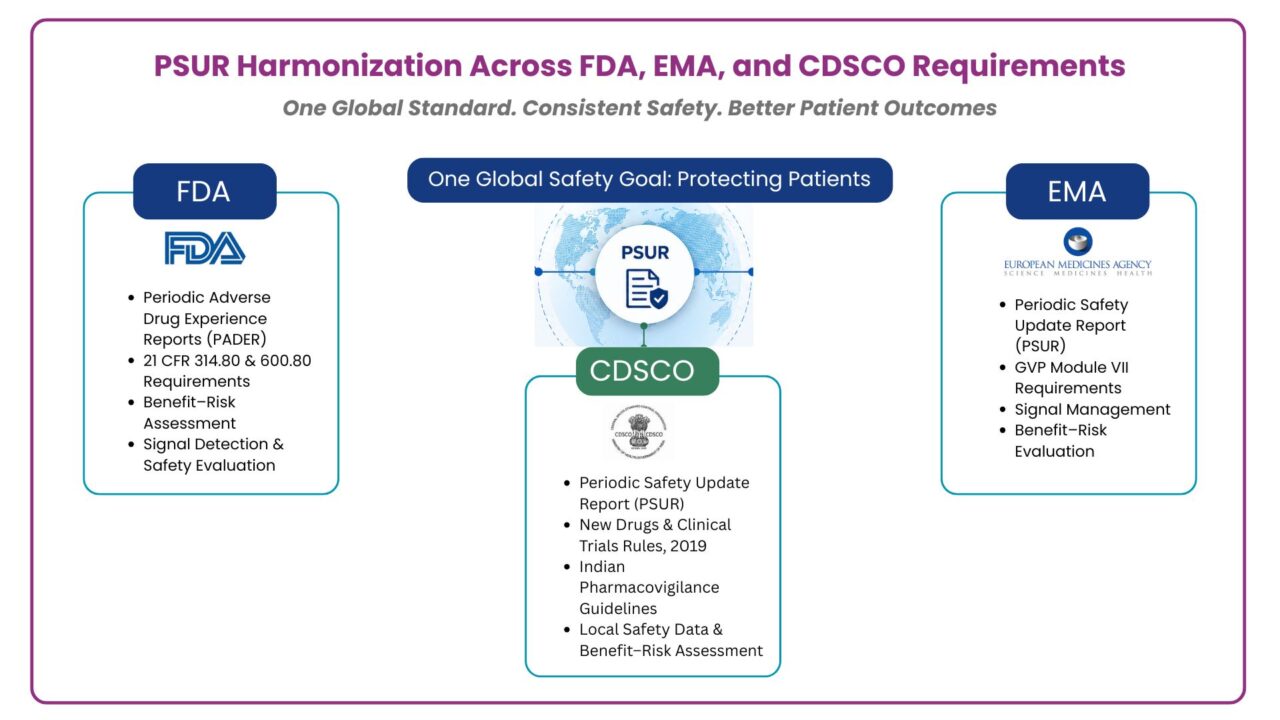
PSUR Harmonization Across FDA, EMA, and CDSCO Requirements

Introduction
As pharmaceutical products increasingly move across international markets, pharmacovigilance teams face growing pressure to maintain consistent safety reporting while meeting the unique expectations of different regulatory authorities. Among the most important post-marketing obligations is the preparation and submission of Periodic Safety Update Reports (PSURs), which provide regulators with an ongoing assessment of a product’s safety profile and evolving benefit-risk balance.
Today, the International Council for Harmonisation (ICH) framework influences pharmacovigilance practices across more than 150 jurisdictions worldwide. At the same time, a single globally marketed product may require compliance with dozens of country-specific regulatory requirements throughout its lifecycle. While the objective of safety reporting remains the same across regions, regulatory expectations can differ significantly among agencies such as the FDA, EMA, and CDSCO.
As regulatory oversight becomes more sophisticated and product portfolios continue to expand globally, pharmaceutical companies are increasingly recognizing the value of harmonized safety reporting strategies. Rather than managing multiple disconnected reporting processes, sponsors are adopting integrated pharmacovigilance frameworks that improve consistency, strengthen compliance, and support long-term regulatory success.
PSUR Harmonization at a Glance
| Key Indicator | Industry Insight |
| 150+ | Jurisdictions influenced by ICH pharmacovigilance standards |
| 2 Million+ | Adverse event reports received annually through FDA safety surveillance systems |
| 20–50+ | Markets that may require safety reporting for a single global product |
| 60–70% | Aggregate reporting effort often spent on data collection, reconciliation, and review activities |
| Hundreds of Thousands | Individual Case Safety Reports (ICSRs) processed annually by large pharmaceutical companies |
Table 1: PSUR Harmonization Across FDA, EMA, and CDSCO Requirements
Why PSUR Harmonization Has Become a Strategic Priority
The role of pharmacovigilance has evolved considerably over the past decade. What was once viewed primarily as a regulatory obligation is now recognized as a strategic function that directly influences patient safety, regulatory confidence, and product lifecycle management. As organizations expand into new markets, the complexity of managing multiple reporting requirements grows significantly.
Large pharmaceutical companies may process hundreds of thousands of Individual Case Safety Reports annually, generating substantial volumes of safety data that must be evaluated, interpreted, and communicated effectively. Industry observations suggest that pharmacovigilance teams can spend as much as 60–70% of their aggregate reporting effort on data collection, reconciliation, and quality review activities. When different regions follow separate reporting processes, this burden increases further, creating inefficiencies and increasing the risk of inconsistencies across submissions.
Harmonization offers a practical solution to these challenges. By establishing a centralized framework for safety evaluation and reporting, organizations can reduce duplication, improve data consistency, and maintain a unified safety narrative across regulatory jurisdictions. This approach not only improves operational efficiency but also strengthens the quality of benefit-risk assessments presented to health authorities.
Understanding Regulatory Expectations Across FDA, EMA, and CDSCO
Although the FDA, EMA, and CDSCO share the common goal of protecting public health, each authority approaches periodic safety reporting from a slightly different perspective.
The European Medicines Agency places significant emphasis on continuous benefit-risk evaluation throughout the product lifecycle. Under Good Pharmacovigilance Practices (GVP) Module VII, PSURs are expected to provide detailed assessments of cumulative safety data, signal evaluations, risk minimization activities, and emerging safety concerns. Regulators carefully evaluate whether the conclusions presented within a PSUR are supported by the organization’s broader pharmacovigilance system and risk management activities.
The FDA follows a different reporting structure, relying heavily on periodic adverse event reporting and post-marketing surveillance mechanisms. The agency receives more than two million adverse event reports annually through its safety monitoring systems, reflecting the scale and complexity of modern pharmacovigilance oversight. Although reporting formats differ from those used in Europe, the FDA remains focused on ensuring that sponsors identify, assess, and communicate safety concerns in a timely and scientifically justified manner.
CDSCO has continued to strengthen its pharmacovigilance expectations as India’s pharmaceutical industry expands its global presence. Marketing authorization holders are expected to provide meaningful evaluations of safety data, benefit-risk considerations, and relevant regulatory actions taken in other markets. Increasingly, sponsors are expected to align their reporting practices with internationally recognized standards while maintaining compliance with local regulatory requirements.
The Role of ICH E2C(R2) in Global Harmonization
One of the most important developments in modern pharmacovigilance has been the introduction of the ICH E2C(R2) guideline, which established the Periodic Benefit-Risk Evaluation Report (PBRER) framework. This guideline shifted the focus of periodic safety reporting from simple adverse event summaries toward a more comprehensive scientific evaluation of a product’s overall benefit-risk profile.
The PBRER framework encourages sponsors to integrate safety findings, efficacy considerations, signal evaluations, and risk management activities into a single assessment. This broader perspective allows regulators to better understand whether a product’s benefits continue to outweigh its risks as new safety information emerges over time.
For multinational pharmaceutical companies, ICH E2C(R2) provides a valuable foundation for harmonization. By adopting globally accepted principles, organizations can develop consistent methodologies for evaluating safety information and presenting conclusions across multiple regulatory jurisdictions.
Comparing Key PSUR Expectations Across Regulatory Authorities
| Reporting Element | FDA | EMA | CDSCO |
| Periodic Safety Reporting | Required | Required | Required |
| Benefit-Risk Evaluation | Moderate Focus | Extensive Focus | Significant Focus |
| Signal Management Assessment | Expected | Strongly Evaluated | Increasingly Evaluated |
| ICH E2C(R2) Alignment | Partial | High | Growing Alignment |
| Global Safety Data Integration | Expected | Required | Expected |
| Inspection Readiness Expectations | High | Very High | Increasing |
Table 2: Comparing Key PSUR Expectations Across Regulatory Authorities
While differences remain in reporting frameworks and terminology, there is growing convergence around the principles of benefit-risk evaluation, signal management, and proactive safety surveillance.
Common Barriers to Effective PSUR Harmonization
Despite the advantages of harmonization, many organizations continue to encounter operational and regulatory challenges that complicate implementation. One of the most significant obstacles involves maintaining consistency across multiple safety data sources. Information may originate from clinical trials, spontaneous adverse event reports, literature surveillance activities, patient support programs, and post-marketing studies, creating considerable complexity during aggregate safety evaluations.
The challenge becomes even greater for globally marketed products that may require reporting across 20 to 50 or more regulatory markets simultaneously. Different submission schedules, reporting frequencies, and data lock points often force pharmacovigilance teams to perform repeated analyses using overlapping datasets. These activities increase resource requirements while creating opportunities for inconsistencies between regional submissions.
Organizations may also face challenges related to fragmented governance structures, varying medical interpretations, and resource constraints. Without a centralized approach, maintaining consistency in benefit-risk narratives and safety conclusions becomes increasingly difficult as product portfolios expand.
Building an Effective Harmonized PSUR Strategy
Organizations that successfully harmonize PSUR requirements typically view safety reporting as an integrated component of their overall pharmacovigilance framework rather than an isolated compliance activity. Effective harmonization begins with establishing strong governance structures that promote consistency in data collection, medical review, signal management, and benefit-risk evaluation.
A centralized safety database often serves as the foundation of this approach by providing a single source of truth for safety information across regions. Standardized procedures for data analysis and report preparation further support consistency, helping organizations present a unified scientific narrative to multiple regulatory authorities.
Equally important is cross-functional collaboration. Pharmacovigilance professionals, regulatory affairs teams, quality specialists, medical writers, and clinical experts must work together to ensure that safety evaluations remain aligned with both global standards and local regulatory expectations. When these processes are supported by strong oversight and clear accountability, harmonization becomes significantly easier to maintain.
Strategic Considerations for Sponsors
As regulatory expectations continue to evolve, sponsors should view PSUR harmonization as more than a reporting obligation. A fragmented approach to safety reporting can create operational inefficiencies, increase compliance risks, and make it more difficult to maintain consistent benefit-risk narratives across regulatory submissions. Establishing a centralized framework for safety data review, signal management, and aggregate reporting can help organizations improve consistency while supporting both local and global regulatory requirements.
Sponsors should also consider how their pharmacovigilance systems will scale as product portfolios expand into new markets. A harmonized reporting strategy built on globally recognized principles, such as ICH E2C(R2), can provide a strong foundation for managing increasing reporting volumes, supporting inspection readiness, and maintaining regulatory confidence throughout the product lifecycle.
What Inspectors Are Looking for During Safety System Reviews
Regulatory inspections have evolved far beyond verifying whether reports were submitted on time. Today, inspectors increasingly focus on the effectiveness of the overall pharmacovigilance system and the quality of scientific decision-making that supports periodic safety reports.
Pharmacovigilance-related observations continue to rank among the most frequently cited findings during regulatory inspections globally. Many of these findings stem from inconsistencies between safety databases, aggregate reports, signal management records, and supporting documentation. Regulators also pay close attention to the scientific rationale behind benefit-risk assessments and the organization’s ability to demonstrate traceability throughout the safety evaluation process.
A harmonized reporting framework can significantly improve inspection readiness by promoting consistency across submissions, reducing discrepancies, and strengthening the connection between safety data and regulatory conclusions.
As pharmaceutical products continue to reach broader global markets, the complexity of safety reporting will only increase. Organizations may be required to evaluate safety information from thousands of adverse event reports while simultaneously addressing the expectations of multiple regulatory authorities, including FDA, EMA, CDSCO, MHRA, Health Canada, and others.
In this environment, PSUR harmonization is no longer simply an operational improvement, it is a strategic necessity. By adopting a unified approach to safety reporting, sponsors can reduce duplication, improve consistency, strengthen inspection readiness, and enhance the quality of benefit-risk assessments presented to regulators.
Ultimately, a harmonized PSUR framework supports what matters most: maintaining regulatory confidence while protecting patient safety throughout the product lifecycle.
References
1.ICH E2C(R2) – Periodic Benefit-Risk Evaluation Report (PBRER)
https://database.ich.org/sites/default/files/E2C_R2_Guideline.pdf
2.EMA – Periodic Safety Update Reports (PSURs)
https://www.ema.europa.eu/en/human-regulatory-overview/post-authorisation/pharmacovigilance-post-authorisation/periodic-safety-update-reports-psurs
3.FDA – FDA Adverse Event Reporting System (FAERS) Database
https://www.fda.gov/drugs/drug-approvals-and-databases/fda-adverse-event-reporting-system-faers-database
4.CDSCO – New Drugs and Clinical Trials Rules, 2019
https://cdsco.gov.in/opencms/opencms/en/Acts-and-rules/New-Drugs/
5.FDA – FDA Adverse Event Monitoring System (AEMS)
https://www.fda.gov/drugs/surveillance/fdas-adverse-event-reporting-system-faers
Frequently Asked Questions (FAQs)
What is PSUR harmonization?
Why is PSUR harmonization important for global sponsors?
What are the key differences between FDA, EMA, and CDSCO PSUR requirements?
How does ICH E2C(R2) support PSUR harmonization?
What are the benefits of harmonizing PSUR requirements across FDA, EMA, and CDSCO?
Recent Posts
- ICSR Processing Optimization for Multi-Country Submissions July 13, 2026
- PSUR Harmonization Across FDA, EMA, and CDSCO Requirements July 1, 2026
- A Sponsor’s Guide to Signal Detection for IND, NDA, BLA, and Post Marketing Programs June 22, 2026
- Risk Management Plans Integration in Global Development Programs March 31, 2026
- Post-Marketing Surveillance (PMS) in Regulatory Affairs: A Complete Guide March 24, 2026