ICSR Processing Optimization for Multi-Country Submissions
👤 Dr. Sornaraja Thasma | 🗓️ 13 July, 2026 | 📂 Pharmacovigilance

Optimize ICSR processing for faster multi-country safety submissions, stronger global compliance, and reduced regulatory risk across pharmaceutical markets.
One ICSR Process Doesn't Fit Every Country
Bringing a medicinal product to global markets means far more than obtaining marketing authorization. Once the product reaches patients, pharmaceutical companies enter one of the most demanding phases of the product lifecycle, continuous pharmacovigilance.
Every adverse event reported from healthcare professionals, patients, literature, clinical studies, distributors, or digital channels must be evaluated, medically assessed, documented, and submitted within strict regulatory timelines. In global programs, organizations often handle 10,000 to 100,000+ ICSRs annually, depending on product portfolio size and geography.
Each regulatory authority follows its own reporting requirements, submission gateways, coding expectations, local language considerations, and reporting timelines. Even mature organizations report 20–35% variability in processing timelines across regions due to inconsistent workflows.
For global sponsors, optimizing ICSR processing is no longer simply an operational improvement. It has become a strategic requirement for maintaining regulatory compliance, inspection readiness, and patient safety.
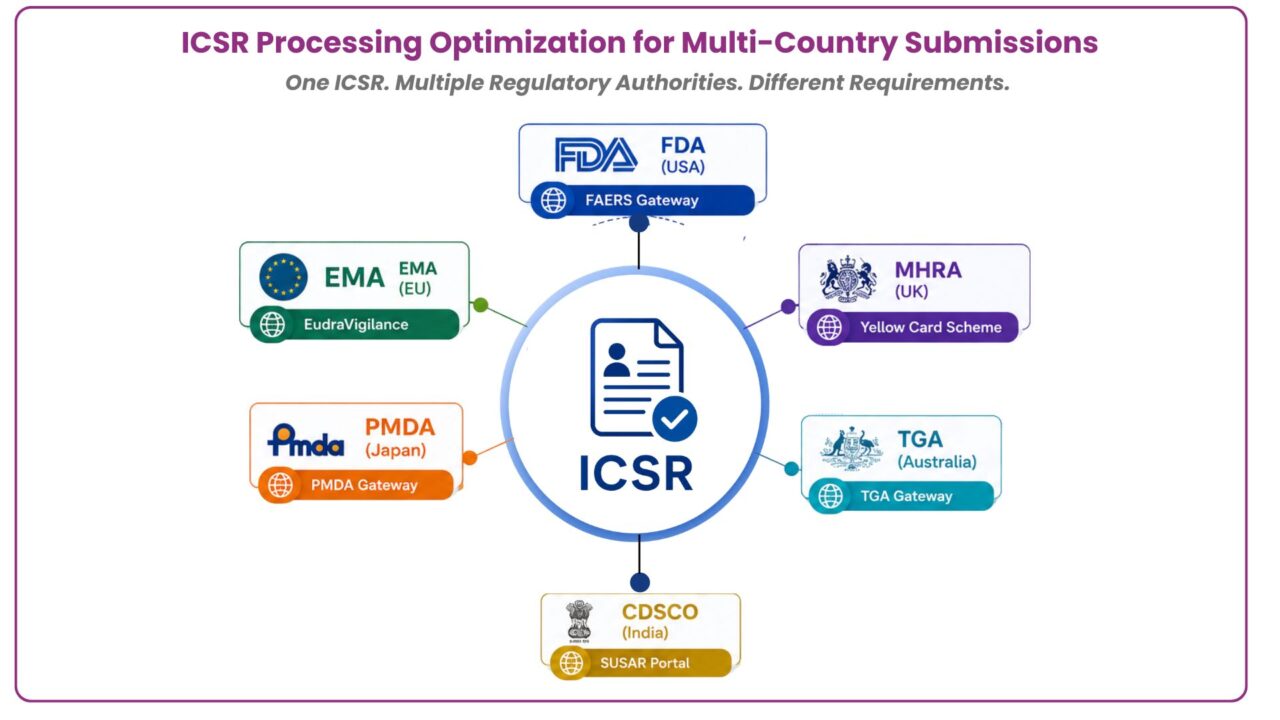
Figture: ICSR Processing Optimization for Multi-Country Submissions
Why Multi-Country ICSR Processing Is More Challenging Than Ever
The complexity of global pharmacovigilance has increased significantly as sponsors expand across multiple regions while managing continuously rising safety data volumes. Regulatory expectations are also becoming more dynamic, requiring faster, more consistent, and highly accurate case processing across all markets.
The pharmacovigilance landscape has evolved rapidly, with global sponsors often managing 30–60% year-on-year growth in safety case volumes across products and studies.
Each Individual Case Safety Report may require assessment for multiple regulatory authorities, sometimes resulting in 2–5 separate submissions per single case, depending on market approvals.
Without standardized workflows, organizations can experience:
Up to 25–40% delays in case processing timelines
Increased duplicate handling burden (up to 15–20% avoidable duplicate cases in fragmented systems)
Higher regulatory query rates during submissions.
Common Challenges Sponsors Face During Global ICSR Processing
| Challenge | Business Impact |
|---|---|
| High global case volumes | Up to 50% surge during product launches or signal events |
| Different regulatory timelines | Missed submissions impacting strict 15-day / 7-day reporting windows |
| Duplicate safety reports | 10–20% operational inefficiency in poorly integrated systems |
| Inconsistent medical coding | Increased regulatory queries and rework cycles |
| Manual workflows | Up to 30–45% higher processing effort per case |
| Multiple safety databases | Data reconciliation delays of 2–4 weeks per cycle |
| Limited resources | Increased risk of inspection findings and CAPAs |
Where Global ICSR Workflows Commonly Break Down
Despite significant investment in pharmacovigilance systems, many organizations continue to face operational inefficiencies because the real challenge lies in fragmented processes rather than technology limitations. As global reporting demands increase, even small workflow gaps can create downstream compliance and quality issues.
Delayed Case Intake often leads to processing lags of 24–72 hours, especially when cases arrive from multiple uncontrolled channels such as affiliates, literature, or medical information teams. This delay can also impact timely triage and push back critical regulatory submission timelines.
Duplicate Case Identification remains a significant challenge, with studies in operational PV environments showing that 10–25% of incoming cases may represent duplicates when systems are not harmonized, leading to redundant submissions and inconsistent narratives. This also increases reviewer workload and creates avoidable reconciliation efforts.
Country-Specific Regulatory Interpretation adds further complexity, as organizations must continuously manage 50+ evolving regulatory variations globally, increasing the risk of non-compliance if not centrally governed. These differences often require additional country-level reviews before final submission.
Resource Constraints also intensify during peak periods, where safety teams may experience 30–60% workload spikes during launches, acquisitions, or seasonal reporting surges. This frequently results in prioritization challenges and extended turnaround times for case processing.
Characteristics of a High-Performing Global ICSR Processing Model
Leading pharmaceutical organizations no longer view ICSR processing as a fragmented regional activity. Instead, they manage it as a unified global system designed for consistency, compliance, and scalability across all markets.
Leading pharmaceutical organizations operating optimized PV systems typically achieve:
20–35% faster case processing timelines
Up to 40% reduction in duplicate submissions
25–30% improvement in submission accuracy rates
These improvements are driven by structured global models:
- Standardized Global SOPs
Reduce variability across regions by up to 30%, ensuring consistent audit-ready processes globally. This also strengthens cross-functional alignment between regional and global safety teams. - Centralized Medical Review
Improves consistency in causality assessment and reduces inter-reviewer variability by 20–25%. It also supports more uniform medical decision-making across different markets. - Advanced Duplicate Detection
Prevents up to 15–20% redundant case processing workload. Early identification also minimizes downstream reconciliation efforts and improves database integrity. - High-Quality MedDRA Coding
Enhances signal detection accuracy and reduces regulatory query rates by 15–30%. It also improves the reliability of aggregate safety reporting and trend analysis. - Built-In Quality Control
Reduces submission errors by 25–40%, improving inspection readiness. This additional oversight layer also helps identify systemic process gaps before regulatory review. - Real-Time Compliance Monitoring
Improves on-time submission rates to 95–99% in optimized systems, compared to significantly lower rates in fragmented setups. It also enables proactive risk mitigation through continuous tracking of critical timelines.
How Optimized ICSR Processing Supports Global Regulatory Compliance
An optimized workflow delivers measurable operational and regulatory advantages.
| Optimization Area | Strategic Benefit |
| Faster case triage | Improved reporting timelines |
| Consistent medical review | Better clinical quality |
| Automated workflow management | Reduced manual effort |
| Global quality oversight | Fewer compliance deviations |
| Standardized coding | Stronger safety data integrity |
| Regulatory tracking | Better inspection readiness |
| Scalable operations | Supports product expansion |
Technology Alone Does Not Create an Efficient Pharmacovigilance Operation
Many organizations assume that implementing a safety database or advanced pharmacovigilance platform is sufficient to resolve all operational challenges. However, in practice, technology is only one part of a much larger ecosystem required for effective global safety management. Without strong processes, skilled teams, and governance frameworks, even the most advanced systems can fall short of expectations.
Successful organizations combine:
Experienced pharmacovigilance professionals
Standardized global processes
Medical expertise
Regulatory intelligence
Quality management systems
Continuous process improvement
Scalable operational support
When these elements work together, technology becomes a true enabler of efficiency, consistency, and compliance rather than a standalone solution.
Building an Inspection-Ready ICSR Function Across Global Markets
Health authorities increasingly evaluate not only whether Individual Case Safety Reports were submitted on time but also how consistently organizations manage their end-to-end pharmacovigilance processes. During inspections, regulators often assess documentation quality, medical assessment consistency, workflow controls, audit trails, reconciliation practices, and evidence that safety data is managed under a robust quality management system.
Organizations with well-defined governance, standardized operating procedures, documented quality reviews, and experienced pharmacovigilance teams are generally better positioned to respond to regulatory inspections while maintaining confidence in their global safety reporting processes.
Scaling Global ICSR with Expert Partners
As ICSR volumes continue to rise across global markets, scalability has become essential for maintaining efficient and compliant pharmacovigilance operations.
As product portfolios expand, internal teams often face growing pressure to manage high-quality case processing within strict timelines. Many sponsors therefore rely on experienced pharmacovigilance partners who can support large-scale operations while ensuring consistency, quality, and regulatory compliance.
At Atvigilx, we recognize that every Individual Case Safety Report reflects a commitment to patient safety and data integrity. Our team supports the complete ICSR lifecycle, including case intake, medical review, MedDRA coding, quality control, regulatory submissions, follow-up management, and compliance tracking. With experienced professionals and standardized global workflows, we help organizations manage increasing case volumes across multiple regulatory regions.
Whether supporting emerging biotech firms or established global pharmaceutical companies, our focus remains on delivering accurate, timely, and inspection-ready pharmacovigilance operations.
Global pharmacovigilance continues to become more interconnected, more data-intensive, and more closely scrutinized by regulatory authorities. Organizations that rely on fragmented workflows and manual processes will find it increasingly difficult to keep pace with growing reporting obligations.
Optimizing ICSR processing is not simply about improving operational efficiency. It strengthens regulatory compliance, enhances inspection readiness, improves safety data quality, and ultimately supports faster, more confident decision-making throughout a product’s lifecycle.
As reporting requirements continue to evolve across international markets, organizations that invest in scalable, standardized, and quality-focused ICSR operations will be better positioned to protect patients, satisfy regulators, and support sustainable global growth.
References
1.International Council for Harmonisation (ICH). ICH E2B(R3) Electronic Transmission of Individual Case Safety Reports
Available at: ICH Guidelines – Efficacy (E2B(R3))
2.U.S. Food and Drug Administration (FDA). FDA Adverse Event Reporting System (FAERS) Database
Available at: FDA Adverse Event Reporting System (FAERS) Database
3.European Medicines Agency (EMA). EudraVigilance Electronic Reporting
Available at: EMA EudraVigilance Electronic Reporting
4.Medical Dictionary for Regulatory Activities (MedDRA). Official Website
Available at: MedDRA Official Website
5.World Health Organization (WHO). Programme for International Drug Monitoring (PIDM)
Available at: WHO Programme for International Drug Monitoring (PIDM)
Frequently Asked Questions
What is ICSR processing in pharmacovigilance?
Why is ICSR processing optimization important for multi-country submissions?
What are the biggest challenges in multi-country ICSR submissions?
How can pharmaceutical companies improve global ICSR compliance?
Why do pharmaceutical companies outsource ICSR processing?
Recent Posts
- PV Audit Preparation Frameworks for International Auditors July 21, 2026
- Pharmacovigilance Outsourcing Services: A Strategic Advantage for Pharmaceutical and Biotech Companies July 16, 2026
- ICSR Processing Optimization for Multi-Country Submissions July 13, 2026
- PSUR Harmonization Across FDA, EMA, and CDSCO Requirements July 1, 2026
- A Sponsor’s Guide to Signal Detection for IND, NDA, BLA, and Post Marketing Programs June 22, 2026

Categories

Archives